

01 Sep, 2026


In the early 1990s, when the West genuinely believed that history had found its direction, Samuel Huntington’s theory of the “waves of democratization” sounded almost like a natural description of the world. It rested on the assumption that democracy advances in tides: it arrives, then recedes, but always returns stronger, driven by economic growth, external pressure, ideological momentum, and parallel developments in other countries. This was the period when the grand formulas of the age – “the third wave,” “democratic consolidation,” “the inevitability of the liberal order” – carried real persuasive force. And in retrospect, it is not difficult to see why.
At the time, the world truly was organized around a single center: Pax Americana. There existed a shared technological environment, an almost unified media landscape, and a relatively stable international architecture. The democratic model possessed not only ideological appeal but also clear material advantages. The third wave advanced as if propelled by a steady, gradually strengthening wind that seemed destined to blow indefinitely – from Portugal to Poland and from South Korea to South Africa.
Today, however, we inhabit a world that corresponds to none of these assumptions. This is where the collision between theory and reality begins. Huntington himself is not “outdated” in the sense of irrelevance; on the contrary, his conceptual logic remains intellectually rigorous. What has become outdated is the world that once made that logic plausible.
The first major difference is digital. Huntington understood politics as a structural process unfolding through institutions, parties, churches, armies, and external models. Contemporary politics, by contrast, unfolds through networks – in real time, without a center, without stable authorities, without pauses. Algorithms can radicalize vast numbers of individuals within days; social movements emerge, burn out, and dissolve into pale memes within weeks; states steadily lose control over crucial domains of their public space. Under such conditions, the idea of a “wave” that gradually rises and spreads across continents begins to sound like a description borrowed from a different climatic zone.
The second difference is economic. Huntington’s theory assumes that modernization favors democratization. By the late twentieth century, this assumption largely held: wealth, industrialization, and the expansion of the middle class went hand in hand with political liberalization. Today we observe something almost diametrically opposed. The fastest-growing countries in the world – China, Vietnam, the United Arab Emirates, Saudi Arabia – demonstrate that authoritarian regimes can not only endure but prosper economically without granting meaningful political participation. This form of “techno-authoritarian modernism” removes the central load-bearing pillar of Huntington’s model: the presumed link between prosperity and democracy.
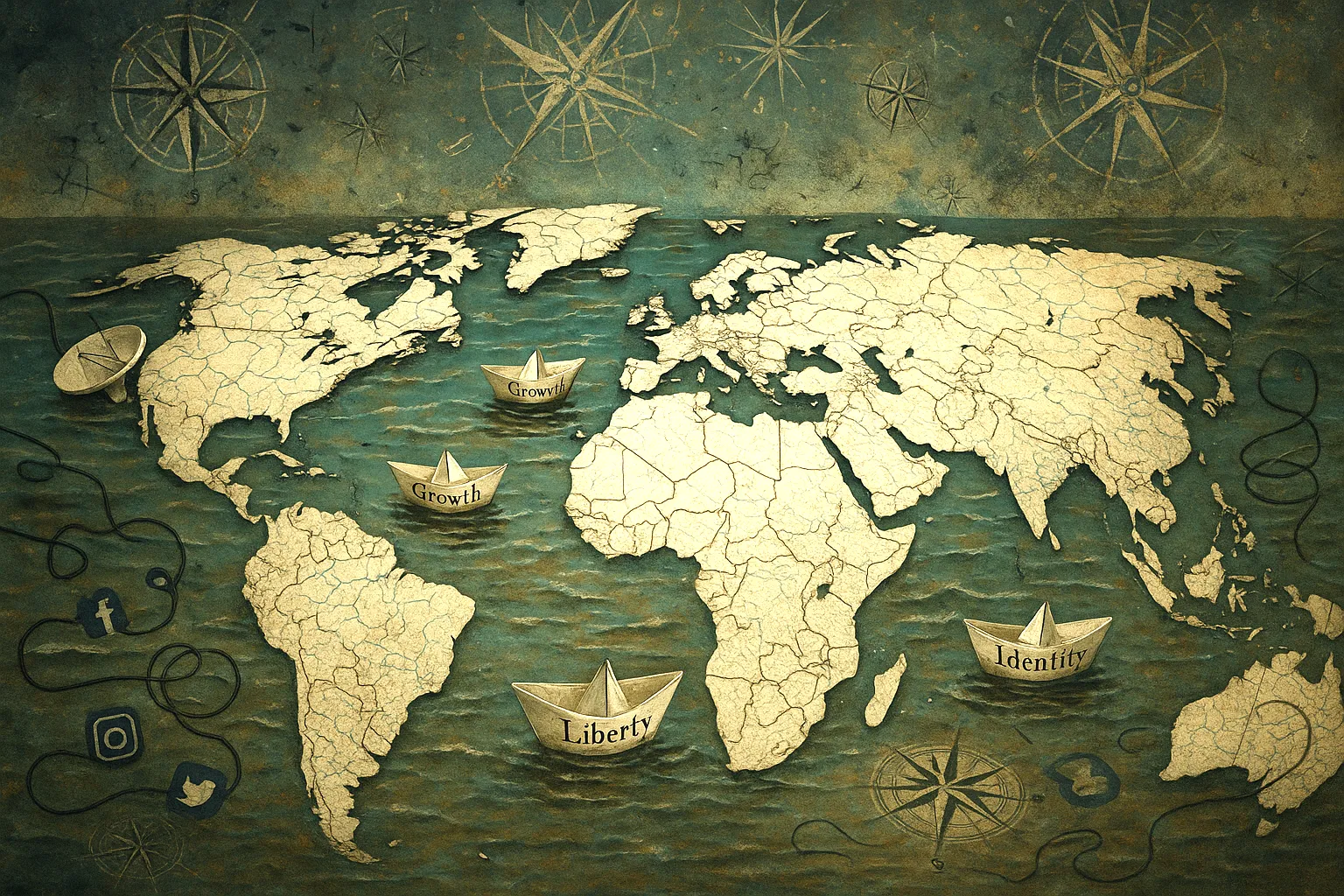
The third difference is geopolitical. The “third wave” was driven by several centers: the United States as hegemon, Europe as a normative model, and the Catholic Church as a reformist institution. None of these forces exists today in the same form. America is internally divided and increasingly incapable of exporting political legitimacy. Europe is paralyzed by its own fragmentation and by its declining international influence. Churches – any churches – have long since lost their role as global agents of modernization. Where the West weakens, new gravitational forces emerge: China as an alternative ideological model, Russia as a disruptive power, India as a hybrid formation combining democratic procedures with ethno-religious nationalism. The world is no longer an ocean traversed by a single wave. It has become a collection of smaller seas, each governed by its own climate.
The fourth major transformation is cultural. Liberal democracy relied on what might be called a universalist imagination: the belief that all societies would sooner or later adopt its principles as their own. Today we live in an era shaped by civilizational nationalism, identity politics, revived religions, ethnic myths, and the accelerating exposure and demythologization of deep historical wounds. The idea of a universal direction of history has evaporated. What Huntington once regarded as an exception – the notion that democracy is not destiny but a historical contingency – has become a widespread intuition. Democracy is no longer experienced as the “normal” state of affairs. The contemporary normality is the proliferation of non-democratic forms.
Against this background, the theory of waves begins to appear almost too elegant, too symmetrical, even faintly moralistic. It presupposes that societies respond to external examples through imitation, that success is contagious, that the force of ideas spills naturally across borders.
Contemporary reality suggests the opposite. Imitation proves most effective where the model is authoritarian. Chinese systems of digital control have become the most widely exported political technology of the twenty-first century. The Russian model of destabilization has been emulated by countless regimes. Orbán has created one school, Salvini another, “MAGA” a third.

Seen from this angle, Huntington would likely be surprised to discover that by 2025 democracy is losing ground not merely because of institutional weakness, but because it has lost much of its capacity to inspire.
This brings us to the central point. The current global dynamic does not resemble a “reverse wave.” In Huntington’s framework, a reverse wave denotes a temporary retreat, followed by renewed advance. What we are witnessing today is something fundamentally different: the disintegration of the very conditions that once made waves possible. There is no shared media landscape, no universally admired model to imitate, no geopolitical centre, no economic mechanism that reliably generates democratization. There is not even a clearly defined social figure of the citizen.
Without these basic prerequisites, the idea of a global democratic wave turns into an abstraction. The world no longer moves synchronously; it pulses in vortices. This is why contemporary regimes appear hybrid, fragmented, and plastic. They hold elections without genuine alternation of power. They speak the language of reform while concentrating control. They look democratic yet operate authoritatively. This is not a temporary “reverse wave.” It is the new morphology of the political.
Is a “fourth wave” still conceivable? The internal logic of our era suggests that if such a movement were to emerge, it would not originate in the traditional centres. It would arise at the periphery, at points of rupture, in societies experiencing not merely dissatisfaction but structural collapse. Democracy can no longer function as an exportable model. If it returns, it will do so as necessity rather than ideology. It will be more decentralized, more local, less national, less dependent on inherited institutions. It will not repeat earlier waves. It may be less grand, but perhaps more durable.
None of this implies that reading Huntington today requires abandoning his theory. On the contrary, it is precisely his framework that allows us to see with greater clarity what the world has become. Whether the theory itself has failed can only be judged by the passage of time. What can be said with confidence now is more modest: the circumstances that once made the great political tides possible have failed.
And if all of this must be condensed into a single metaphor: the waves of democracy have not stopped.
What has stopped is the sea in which they once moved.
