

01 Sep, 2026


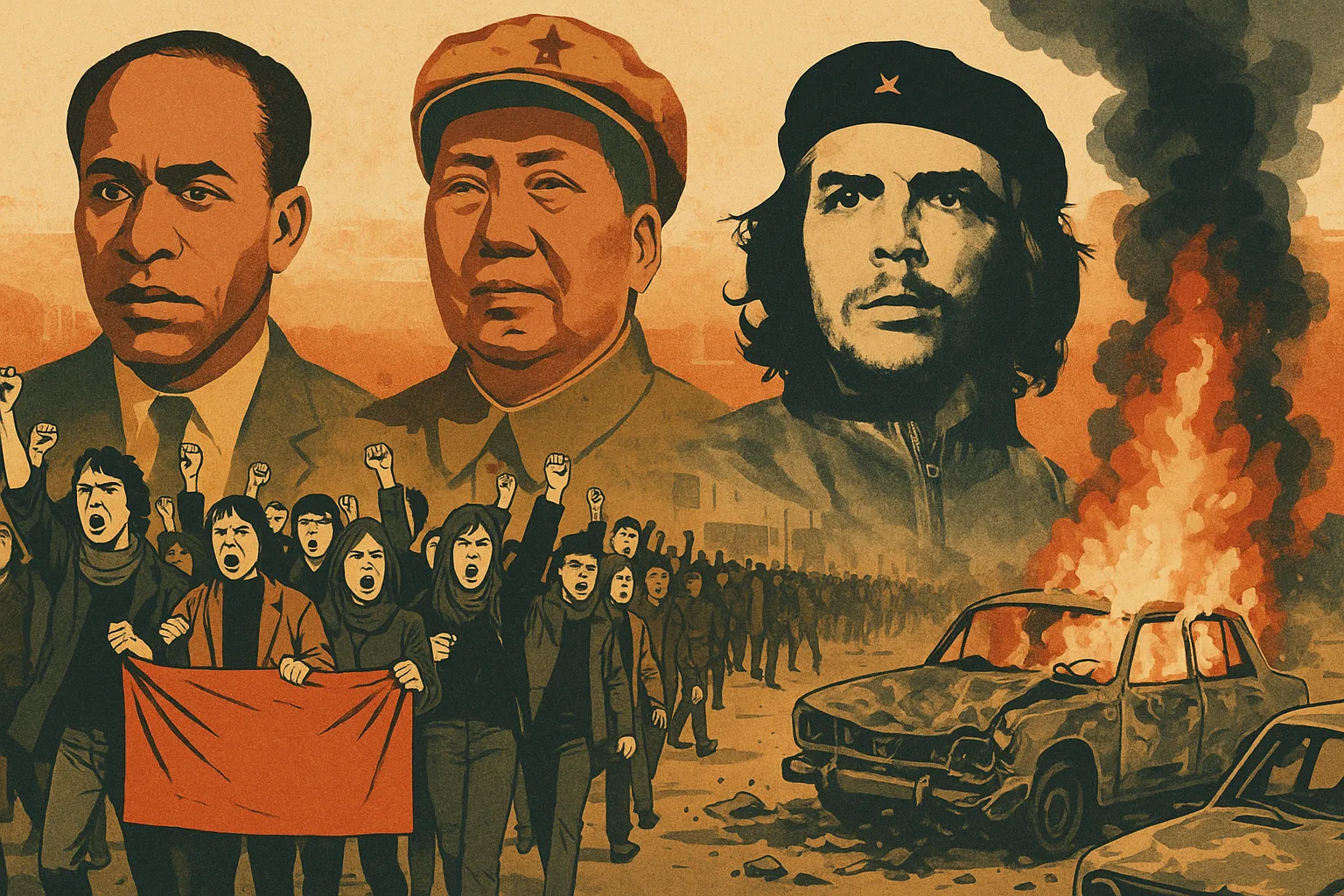
In recent years I have found myself increasingly confronted with an old yet stubbornly persistent way of thinking: the assumption that the oppressed are, by definition, right, and the powerful, by definition, guilty. One of my more recent exchanges on the Net brought this into sharper focus. What I encountered was not simply a set of political opinions, but an entire cultural tradition — or paradigm, if one prefers a more elaborate term — a mode of reasoning that begins with compassion and gradually evolves into a logic that exempts the “weaker” side from responsibility for its own actions.
According to this logic, the weak and the oppressed are entitled to disregard the established “bourgeois” norms of universal ethics — “do not steal,” “do not kill,” and the like — because they have always existed in conditions of subjugation whose dismantling is assumed to be impossible without revolutionary violence. From this follows a familiar conclusion: violence committed by the oppressed is fundamentally different from the violence of the oppressors and therefore cannot be judged by the same allegedly hypocritical moral standards.
At first glance, this reasoning appears humane, since it grows out of genuine empathy for real suffering. At a certain point, however, context — instead of helping us understand — begins to function as justification. The boundary between cause and guilt becomes blurred. Violence is no longer evaluated on the basis of what it is, but on the basis of who commits it. Universal ethics — “do not kill,” “do not steal,” “do not excuse cruelty” — is gradually displaced by a different, tribal morality: “us” versus “them,” “victims” versus “executioners.”
One of the foundational figures in this tradition is Frantz Fanon. He describes colonialism as a system that thoroughly dehumanizes the colonized subject. Within that framework, the violence of revolt appears as the only possible means of reclaiming dignity. Fanon speaks of it almost as a form of psychological release. In the concrete situations he analyzes, this is understandable. The difficulty arises later, when this specific diagnosis is turned into a general formula: the oppressed possess moral legitimacy simply by virtue of being oppressed, and their violence is categorically distinct from that of power. A psychological insight thus hardens into a moral axiom.
A second pillar of this paradigm lies in communist revolutionary thought. In Mao, truth invariably resides “on the side of the masses.” Che Guevara adds a romantic vision of revolution as a harsh but purifying ordeal. Violence becomes part of the revolutionary’s inner labor, a necessary stage in moral transformation. Gradually, a schema emerges in which the powerful are wrong because they are powerful, and the weak are right because they are weak. Morality ceases to function as a measure of actions and becomes instead a function of position within a structure.
By the 1960s, this way of thinking had largely detached itself from its original historical contexts and assumed the status of a broader cultural paradigm. In the United States, France, West Germany — wherever the state was perceived as the bearer of structural guilt — violence “from below” increasingly came to be seen as morally distinct. Student movements, segments of the intellectual elite, and left-wing groups of various kinds all embraced, to varying degrees, the idea that the brutality of power was criminal, while brutality directed against power represented a form of “historical necessity.”
The distance from this logic to organizations such as the Red Army Faction or the Red Brigades is considerably shorter than we are usually willing to admit. For their members, the world was a battlefield between oppressors and oppressed. Killings and kidnappings were not crimes but blows struck against “the system.” They did not understand themselves as individuals performing concrete acts and bearing responsibility for them, but as embodiments of a historical role. Revolutionary ethics thus took on the character of a secular theology: violence was judged according to whom it served, not according to what it actually was.
Today, the same logic survives in a softer yet unmistakably familiar form. In certain academic and activist environments, it has become common to think about morality primarily through identity. Individuals are evaluated not by their actions, but by the categories to which they belong. Groups that have been historically oppressed are granted an almost automatic moral advantage; those associated with privilege are treated as bearers of structural guilt. On the surface, this appears to be a continuation of the struggle for justice. In practice, it leads elsewhere: to the erosion of personal responsibility.
When you tell the oppressed that they do not bear full responsibility for their actions, you also deprive them of full agency. You reduce them to symbols, to role-bearers, to carriers of innocence by birth. However compassionate this may appear, it is also a form of condescension. The powerful, too, are reduced — to abstractions, to “bearers of guilt,” regardless of their concrete conduct. In place of justice, we are left with rigid lines of division and deepening alienation.

This is why, whenever I encounter the claim that “the oppressed are always right,” I see in it not only the understandable human impulse to side with the weaker party, but also the danger of turning suffering into a form of moral currency — one that can be used to purchase anything, including new forms of violence.
Universal ethics, however abstract it may sometimes appear, remains the only framework within which both the weak and the strong can be regarded as human beings rather than as roles. It is uncomfortable precisely because it does not permit easy justifications. Yet only this framework can interrupt the vicious cycle in which yesterday’s victims find themselves tomorrow in the role of executioners — convinced that history has already absolved them in advance.
