

20 Sep, 2026


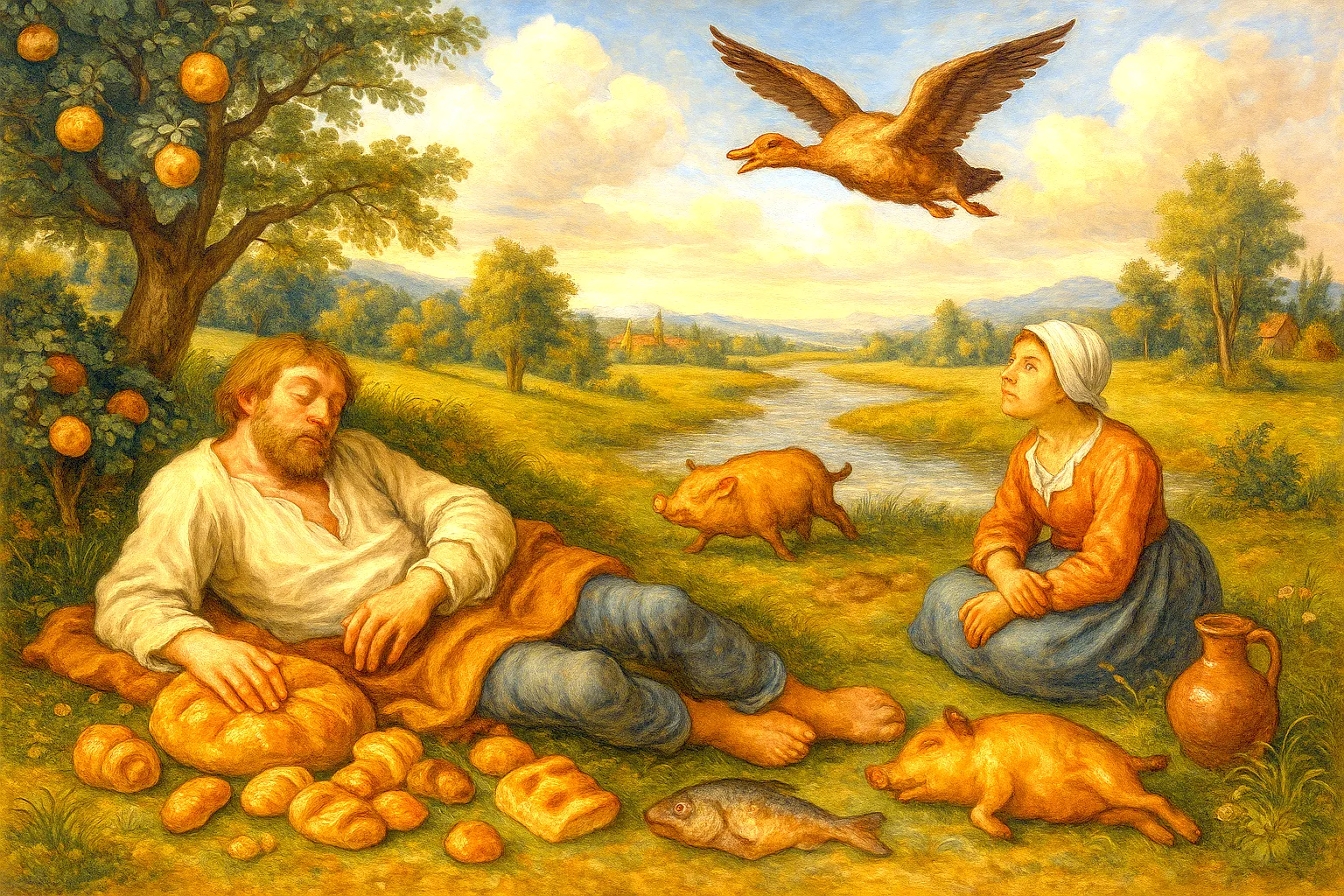
The meadow stretches out under an easy afternoon sun. A man lies beside a mound of pastries, one hand resting lightly on a loaf he never bothers to take. A woman sits a few steps away, watching a roasted goose drift in slow circles above her, carried by a mild breeze. Near them, a pale river moves without making a sound, its surface perfectly smooth. Nothing in the scene seems rushed or purposeful. Everything appears suspended in a kind of warm, unbroken ease – the sort of comfort that invites no action and discourages even the smallest desire.
A breeze passes over the grass, but even that feels half-hearted. The goose above the river keeps tracing the same slow circle, as if it has forgotten how to land. Nothing changes. The hour seems content to stay exactly where it is.
Medieval storytellers had a name for this place. They called it Cockaigne.
Cockaigne was not heaven. It was a joke. Peasants who spent their days bent over fields imagined a country where the fields bent over them. There, food grew ready-cooked on trees. Rivers ran with wine. Fat animals wandered the roads already roasted, waiting to be eaten. It sounds like a paradise invented by exhaustion. But the medieval stories are not naive. They understood something that our age, with its fantasy of automated everything, prefers to ignore: a world in which nothing is demanded of you is not a blessing. It is a slow method of erasing you. Life in Cockaigne is not tragic. It is worse: dull. There is no risk of starvation, but also no real appetite. Time doesn’t move forward; it thickens, turning into an afternoon that never ends.
What the storytellers of Cockaigne understood is that a world without resistance does not stay innocent for long. Sooner or later, ease becomes a kind of pressure of its own. When nothing pushes back, the person facing the world begins to evaporate. The instant abundance becomes automatic, human agency begins to thin out. It is not suffering that disappears first, but the sense of necessity — and with it, the capacity to choose, act, or want anything beyond the next warm afternoon.
There is a strange moment in the life of every system when its greatest success becomes a quiet form of failure. The closer a world comes to anticipating every need, the more it begins to resemble Cockaigne — a place that works so well it begins to feel detached from anything recognizably alive. A solved environment doesn’t simply remove obstacles; it removes the friction that once made action meaningful. And once the resistance is gone, the person inside the system starts to flatten out, like a muscle that no longer remembers movement.
I’ve seen this before. Not in myth. On a chessboard.
Correspondence chess has turned into a curious little theatre. Two very serious people sit at their desks, each pretending to battle the other, but the real work is done by engines humming politely in the background. The moves that appear on the board are flawless and antiseptic: they are machine-made. The players might nod, frown, or deliberate — that is, simulate the gestures of thought — yet the decisions were taken hours ago by software that cannot even imagine anything like „victory.“ What you end up watching is not a contest but a reenactment: two humans acting out the motions of struggle long after struggle has left the building. It has the strange charm of ceremony and the melancholy of a job that continues simply because nobody remembered to cancel it.
What happens on that chessboard is not confined to chess. It is what occurs whenever a human activity becomes too efficient for its own good. Once the hard parts are delegated to systems that don’t tire, doubt or hesitate, the human role shrinks to supervision and ceremony. We stay in the loop mostly because no one has figured out how to redesign it without us. The task is flawless, but the person performing it begins to feel strangely optional, as if the world has learned to continue without waiting for human intention to catch up.
We have built a culture that dreams, quite openly, of removing difficulty from every corner of life. Friction is treated as a design flaw. Slowness is a bug. Uncertainty is a temporary failure of prediction. If you follow this logic far enough, you arrive not at liberation but at a world that feels eerily similar to Cockaigne: a place where almost everything works, yet almost nothing needs you. The only thing missing is the smell of roasted geese drifting over the river.
In this sense, artificial intelligence is not a disruption but a continuation. It pushes the logic of solved environments to its natural extreme. Tasks that once required effort, skill, or doubt now glide forward with mechanical confidence. The systems are faster than us, more consistent than us, and — crucially — indifferent to the things that once gave human action its texture: hesitation, error, ambition, fear. They don’t struggle or aspire. They simply execute. And in their growing competence, we begin to see the outline of a world that functions beautifully while quietly sidelining the very creature it was built to serve.
Most discussions of artificial intelligence circle the same set of worries. Killer robots. Mass unemployment. Machines that wake up one morning and decide to treat us as a rounding error. Surveillance states powered by algorithms that never sleep. Superintelligence rising up to take control. Et cetera, et cetera.
These scenarios come prepackaged, like a shelf of disaster movies we keep rewatching. They offer drama, scale, and the comforting sense that the danger will at least be obvious when it arrives. But while we argue about which science-fiction script deserves top billing, something quieter is already happening in plain sight.
The danger that actually matters rarely looks like a crisis. It looks like ease. Systems become smoother. Tasks complete themselves. Decisions arrive pre-polished. Little by little, the rough edges that once forced us to think or choose begin to disappear. Nothing catastrophic happens; there is nothing like alarms, uprisings or cinematic moments of takeover. Instead, the world tilts toward convenience, and we tilt with it, barely noticing that we are surrendering the very frictions that once kept us awake.
The first thing to go is not our jobs. It’s our texture. The small negotiations with difficulty that shaped how we learned, decided, hesitated, you name it. When everything becomes easy, the inner scaffolding that once held a person together starts to loosen. We don’t become obsolete; if anything, we become thinner and thinner. The world still functions, but it no longer needs the slow and stubborn processes of forming human character. At some point the systems just keep everything in a state of frictionless moving, and we start to feel like guests in our own capacities.
Meaning doesn’t survive in a frictionless world. It clings to resistance the way burrs cling to an animal’s fur. Every experience we later call meaningful begins with something that refused to cooperate: a difficulty or a pause — some small piece of the world that wouldn’t move out of the way. Remove that, and life doesn’t become safer or happier; it just feels thin. Events still roll past, but they no longer catch on anything inside us. Choices still appear, but nothing hooks. The world keeps turning, and somehow we start slipping through it.
We’ve seen versions of this pattern before, scattered across places that seemed unrelated. A medieval dream of effortless abundance. A modern game that continues long after human struggle has left the room. And now a technology that absorbs difficulty with the same quiet appetite. None of these are crises. They are symptoms of a world drifting toward the logic of the solved: systems that run smoothly, tasks that complete themselves, and people who stay involved mostly out of habit. The details change — geese on the breeze, perfect chess moves, predictive algorithms — but the structure is the same. Ease expands, and something in us recedes.
We tend to imagine that the future will challenge us with dramatic choices. But the real choice is already here, and it’s smaller and quieter, almost embarrassingly simple. It’s the choice between a life that still pushes back and one so perfectly arranged that we barely feel ourselves inside it. In a world drifting toward the logic of the solved, this difference becomes decisive. The more smoothly things run, the easier it is to forget that difficulty was not a flaw in the human condition, but the medium in which we learned to move, think, or want anything at all.
Cockaigne was always meant as a joke — an exaggeration, a tongue-in-cheek warning told with a smile. Correspondence chess was never meant to become a parable of our century. And AI, for all the headlines, isn’t the villain in a story about human extinction. What all three reveal is something far more ordinary and much harder to talk about: the quiet possibility that we may end up living in a world that works beautifully while asking almost nothing of us.
The machines won’t replace us in any dramatic sense. They’ll just keep doing the hard parts, and we’ll get used to that arrangement. Bit by bit, the weight of being someone slips toward the systems that handle everything so competently. Nothing breaks. Nothing explodes. The world grows easier, and in that ease we begin to drift — not necessarily toward catastrophe; it is rather a version of life where the struggle that once shaped us has gone missing. But that is more than enough.
If there is a danger, it’s this: that one day we wake up in a world that functions impeccably, and discover that the people inside it are starting to feel optional. Not because anyone pushed them out; it happened simply because ease, taken far enough, quietly pushes everything else aside.
