

20 Sep, 2026


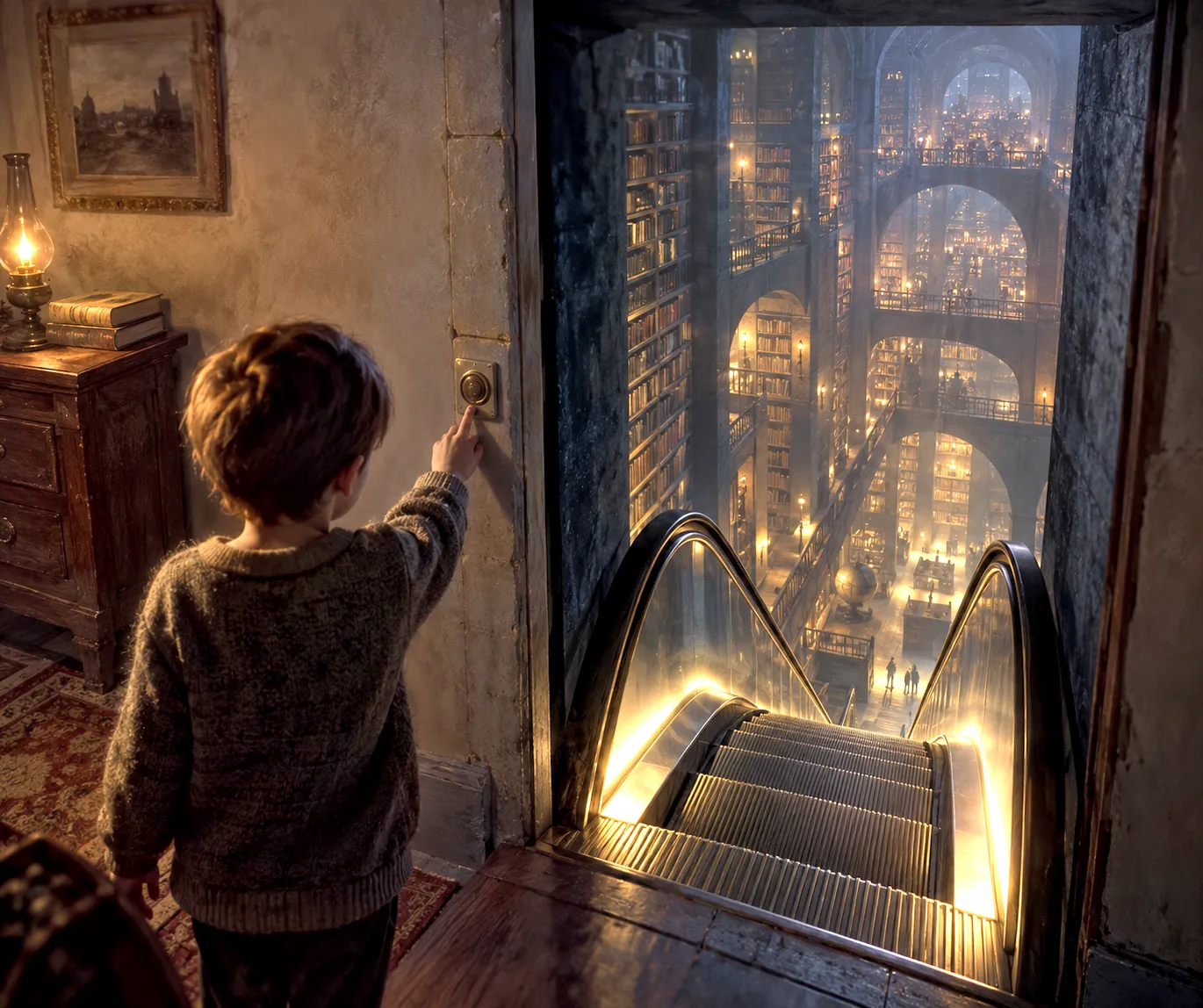
As a child, I had a dream that returned with such persistence that I can still feel the itch of it today. It was not something I dreamt in my sleep, at least not as far as I can remember. More like a place I could go whenever I wanted, somewhere I could hide and forget everything.
Somewhere in the old, ramshackle house there was a hidden button. I do not remember exactly where, and perhaps I never knew. I would press it and part of the wall would open; behind it an escalator would appear, and I would start down.
There was a library down there. An enormous, endless library, although I doubt I would have used the word ‘endless’ when I was seven or eight. I simply never imagined where it ended. There were halls, corridors, shelves upon shelves, all somehow calmly and evenly lit, with nothing magical about them. It is strange how matter-of-fact the whole thing was. I do not remember imagining treasures, chests of gold, pearls or diamonds. All I wanted were books. But not just books: all the books there are. As simple as that. All of them. Full stop.
I have no idea where that escalator came from. As far as I remember, there wasn’t a single one in the town where I grew up. But the descent had to be long. Beneath the house, the yard, the street and all the other houses lay another world, incomparably larger than the one above. And all you needed to get there was the button. No permission, no explanations. You press it, the wall opens, and down you go.
Today I find it difficult to remember what I felt as I wandered through that magical space. Most likely it was ordinary greed, hence the itch I mentioned earlier. I was mad about books and wanted lots of them. Except that ‘lots’ is not quite right. Lots of books could fit on a shelf, in a cupboard, in a room. There would have been no need to excavate half the earth beneath my home town for those. That underground place had to contain everything I might ever want, including things I did not yet know I would want.
I had other dreams of this kind. One of them seems even stranger to me today. I imagined that a person might possess a mind capable of holding all the knowledge in the world. I even tried to formulate it with a child’s desire to lend the dream some ‘scientific’ plausibility: if all the cells in my brain could be shrunk to the size of atoms, would that allow me to cram the knowledge of it all inside? Dear little seven-year-old Baron Munchausen, tugging at his own pigtail to pull himself out of the swamp.
In short, I wanted to know everything. How things worked, how they had come about, what had been there before and what lay behind them. Whenever someone explained something to me, the answer immediately led to another question, and then another, until eventually the adult would say, ‘How should I know? Now be a good boy, go and play for a while!’
But how could you not know? Someone had to know. Somewhere there had to be an answer. Even now I can remember how painful I found those three words: ‘I don’t know.’
I hope you can sense what I have always been after, for as long as I can remember: not something as silly as the dream of becoming a great sage, much less of being intellectually superior. I wanted knowledge itself. I wanted it with an intensity I can compare only to hunger, though even that is not quite right, because hunger comes to an end. You eat, and at some point your body says: enough. With me there seemed to be no such ‘enough’. Every new thing did not fill a space but opened another one. The world did not grow smaller as I came to know it. On the contrary, it only grew larger.
It must have started very early, because I remember something else as well: how I tried to talk about it. Not necessarily about the library. More about the desire. About wanting somehow to encompass everything, to understand it, to have it inside me. My memories become hazier here. I could not reconstruct a particular conversation, and I do not want to invent one. I remember only the reaction. The adults smiled. The children avoided me.
No one was cruel to me. That matters. I was not some little accursed dreamer surrounded by insensitive philistines. I would probably laugh too if a child told me today that he wanted to know everything in the world. What else are you supposed to do? The desire is absurd. Being an adult means already knowing what the child does not yet know: that life is a succession of choices, and every choice means giving something up. That a person can become good at a few things, truly love a few people, read a few thousand books, given enough time. And that this is already an enormous amount. The people around me, of course, simply knew this.
I did not. Worse still, I am not sure that even today I understand why it necessarily has to be that way.
Somewhere here, if I go back far enough, I can see something that after all these years I recognise without the slightest difficulty. The boy in that out-of-the-way Bulgarian town knows very little about the world, but the central problem of his life is already there: he cannot accept human limits as something natural. Behind every door there must be another room, behind every answer another question, behind every wall something hidden. You need only find the right place, the right book, the right button, and the wall will open.
Sometimes I think the word ‘curiosity’ is far too innocent for this. Curiosity can be satisfied. This was something else, something insatiable that for a long time I mistook for a strength. It made me read, search, leave places, begin things I was neither prepared nor qualified for. I owe it almost everything I value in my life. But it has also been a torment: a dull, unceasing, unquenchable hunger.
⸻ ❦ ⸻
For many years I took it for granted that the problem was access. Where I grew up, in the 1960s and 1970s, most of the world was simply out of reach. Books could not be found, films could not be seen, places could not be visited, people could not be met. There was a clear and insurmountable boundary between the world from which an occasional trickle of light reached you and the one actually within your reach. And that boundary was so ordinary, so tangible, that it was easy to mistake it for the way the world itself was made.
Perhaps that is why, for so long, I regarded every boundary with suspicion. If someone told me something could not be done, I rarely asked why. I simply started looking for a way around it. And often I found one. Many supposedly impossible things turned out to require only more time, a certain brazen ingenuity, or a refusal to accept someone else’s ‘no’.
Only much later did I understand how dangerous a habit this was. Not every limit is imposed by bureaucrats, states, poverty, fear or someone else’s stupidity. But when you are young and have repeatedly found a door where everyone assured you there was a wall, it does not occur to you that perhaps some walls ought to be respected.
I think this is also where one of the less attractive features of my character comes from. Anger. I do not know whether it was always there or whether I gradually learnt it because it proved useful. For a long time, at any rate, I did not experience it as a problem. Anger was more of an engine, sometimes even a good friend. Someone closes a door and I become angry enough to find another. Someone underestimates me and anger does what self-confidence cannot: it gives me strength, at least for a while. Someone tells me what I am not entitled to, and almost automatically I begin to want precisely that.
It is not difficult to build an entire biography on something like this.
Only much later did I begin to notice what happens when the wall cannot be circumvented. When what stands on the other side is not a stupid bureaucrat or a closed border, but another human being. You can rage as much as you like, but you cannot make someone love you. You cannot force someone to see in you what you believe yourself to be. You cannot make a publisher want your book, a friend stay, a child live the life you would have chosen for them.
But you can try, of course. The results are rarely pretty.
I do not know how many times I have done it. Certainly far more often than I care to know. Anger feels strong. Dependence feels weak. Contempt is incomparably more comfortable than waiting. And sometimes saying ‘I don’t need it’ is the only way not to say ‘please’.
That has closed more doors than I care to count.
I do not think I am incapable of asking for help or of being grateful. This is something else: a strange combination of fanatical persistence when it comes to the ‘big projects’ of my life, and an almost childish inability to utter the word ‘please’ when there is no bargain to be struck and no way of proving to myself that I deserve the outcome.
Please love me. Please don’t leave. Please tell me what I have done matters. Please don’t let it be over. Please give me a little more.
There is a kind of dependence in sentences like these that I have found almost physically unbearable all my life, because after them comes a pause, and in that pause the other person is free.
Narcissism is only one of the words for this, and I see little point in running away from it. A person who spends his entire life wanting only one thing, ‘more, more!’, who finds rejection hard to bear and experiences another person’s judgement as an encroachment, may well be exactly that: an irredeemable narcissist. I have no desire to turn this essay into a trial in which I am eventually acquitted on account of mitigating circumstances. Some people have endured my anger. Many, incomparably more, have not. The results are sobering enough: at sixty-five, I am still about as far from satisfaction as I probably was at six and a half.
It would be convenient to tell the story of my life as that of a man who was always missing something. But that would not be true. I have received, and continue to receive, an enormous amount. The painful realisation at this age is that even in my happiest moments there has always been some crack through which I could glimpse that unattainable, eternally receding ‘more’.
A good book is never simply a good book. It opens a door into an endless labyrinth of other things, more fascinating still because they are unknown and out of reach. A love opens up another person, and that person turns out to be a world you can never fully explore. A journey merely increases the number of places you want to see. Even understanding seems to work this way: the more you learn about things, the less you can pretend to know them.
And so, without my noticing when it happened, the dream of the underground library became something like the operating principle of my life. Except that now there was no library and no button. There were countless small discoveries, each promising for a moment that same old thing, only to open onto something larger and still unknown.
For a long time this did not frighten me. And why should it have? There was time. At least, there used to be.
⸻ ❦ ⸻
I cannot remember when I first began to grasp the limit.
There was probably no single moment. Rather, certain words gradually changed their meaning. ‘Later.’ ‘When I have time.’ ‘Someday.’ I went on using them, but something had begun to enter them that had not been there before. A small uncertainty, almost imperceptible at first. One that gradually grew, strangely at odds with everything happening around.
Because the world was opening up.
I mean this quite literally. The world was opening at such a pace that even now I sometimes find it hard to believe how much changed in one lifetime. Borders opened, archives opened, vast spaces that had once been unimaginable became accessible. And it all happened so fast that perhaps we could absorb it only because everyone was being carried along.
For me, this meant things that would once have seemed impossible. Books I had searched for over years began appearing within seconds. Music for which you once had to know someone who knew someone who owned the record became available at the touch of a finger. Films, archives, old newspapers, libraries on the other side of the world, conversations with people you would once have had to travel thousands of miles to meet. Even languages began to lose some of their power. Then came the final, almost indecent miracle: the possibility of asking a question and having someone, or something, follow it with you, however far it might lead.
Of course, none of this happened overnight. Perhaps that is why I failed to notice it. Until one day something suddenly dawned on me:
That boy had got his library.
Everything I had thirsted for all the years was literally at my fingertips. More books than I could ever read. More music than I could ever hear. More films than I could ever watch. I am not talking about one lifetime, but a hundred, a thousand, millions of human lives. The knowledge shimmering before me today is more than I could absorb even if, from this moment on, I did nothing else until the end of the world.
I ought to feel as though I were in paradise, shouldn’t I? For a while, perhaps I did. Except that along the way something changed that I still cannot describe without a sense of shame.
I began to be afraid of the library. And not of the bad books, but of the good ones.
It happens to me more and more often. I discover a writer or a subject I know nothing about. I start looking, usually without much interest, but ten minutes later I begin to feel that I have stumbled upon something real. I read a little more, find the books or articles, begin to see the connections leading to other writers, other subjects, other times. The old mechanism starts up at once. I feel almost the same excitement I must have felt fifty years ago at the thought of those underground shelves.
And somewhere inside that excitement, fear appears.
I cannot say exactly when. Sometimes within the first few minutes. Sometimes later, when I have already gathered the books and they are staring back at me from the screen.
And suddenly, instead of the old ‘I want’, something entirely different pierces me: ‘But when? When, for God’s sake?’
Because I had not dreamt merely of access. I had access now, on a scale the child could never have imagined.
What I had dreamt of was being able to take it all in.
All my life I had thought the thirst was so unbearable because the world gave me too little. And then it opened its doors. The walls fell one after another, the boundaries became transparent, the library became unnecessary, and in its place appeared something I had never been able to imagine: an ocean. An ocean of knowledge drifting lazily past, indifferent to me and to my bewilderment before it.
⸻ ❦ ⸻
And then came the realisation that would once have been unbearable: the bars I had believed were gone were not where I had spent my whole life seeing them.
Perhaps that was the hardest thing to accept. I was used to thinking of the world as a place that put obstacles in my way. I had spent so long pushing against them that gradually I had come to believe in a simple rule: a wall exists to be broken through. If you fail, it only means you have not yet found the way.
But there seemed to be no way through this new wall, with its new bars.
I could read faster, but not infinitely so. I could sleep less, until my body demanded its due. I could become better organised, discard what was unnecessary, be more careful about what I gave my hours to. I could use every new machine that promised to save me time, and I did so with almost childlike eagerness. Somewhere deep inside me, the conviction was evidently still alive that if only I were clever enough, fast enough and disciplined enough, somehow, in the end, the arithmetic would work.
And it refused to.
Perhaps you have to grow old to understand the true difference between a great deal and infinity. As long as time itself seems infinite, the distinction hardly matters. A thousand books, ten thousand books, all the books in the world are merely different degrees of ‘there is more’. You live with the sense that the road goes on, with no need to know where it ends. But once you begin to see the end of your own road, the quantity on the other side suddenly takes on a different meaning. It is no longer a promise. Sometimes it is a sentence.
It is not that at sixty-five the word ‘someday’ has disappeared from my vocabulary. I simply know now that in a great many cases it means ‘never’.
I am not sure when that knowledge began to bring tears to my eyes.
This is an unusual predicament for someone so practised in anger. Anger needs an address. The state, the family, society, the provinces, the publisher, the person who failed to understand you, the one who chose someone else, historical accident, bad luck. Even God will do, if you believe in him. You can always find someone at whose door to leave the bill.
But whom am I supposed to be angry with because a human brain can absorb only so much? Whose fault is it that a day has twenty-four hours? Who decided that I can be in only one place at a time, that I can live only one life, that every ‘yes’ consumes the time of countless other possibilities? Where am I supposed to lodge my complaint that I cannot go back to an afternoon in 1987 and live it once again, this time knowing what it was?
At this point anger begins to look a little absurd. I do not mean that it necessarily disappears. It simply has nowhere to go.
Perhaps that is why, in recent years, I have found myself returning more and more often to a poem that has accompanied me since my youth. Rilke’s panther circles behind its bars, and through the thousand bars before its eyes the world gradually disappears. I do not want to explain poetry. It does not need explaining, and I would probably only spoil it. Something else has always haunted me: the immense strength still there in the animal. It has not disappeared. The panther has not become any less of a panther. And that is precisely what makes the cage unbearable.
Now I understand why this image will not leave me. The thirst hasn’t aged with me.
⸻ ❦ ⸻
A human being is a finite creature capable of conceiving infinity.
When I first wrote that sentence, it struck me as somehow naturally beautiful. I no longer feel that way about it. Now it seems monstrous.
Why? Why have I been given this thirst if there is nothing that can quench it?
I don’t know.
And here, for the first time in a very long while, I do not immediately feel the urge to find an answer.
Perhaps that is what the tears I do not understand are about. I do not well up over one unread book. That would be ridiculous. I do not even well up because old age is catching up with me step by step, though I am sure that is part of it too. What brings the tears is the mismatch. That enormous, reckless ‘I want’ which, for some reason, has not diminished along with the time I have left. The same ‘I want’ in the boy who was utterly convinced that somewhere there had to be a button, and in the old man who, after a lifetime of searching, has finally found it.
The wall has opened. The escalator is running. All the books are down there. Except that the child now knows he will never be able to read them all.
⸻ ❦ ⸻
This is where the consolation ought to begin.
The temptation to write it is almost physical. You are not supposed to end a piece of writing on your knees; at least, that is what we are taught. You are supposed to get up, dust off your trousers and find some meaning in it all. To say that limitation gives life its value, that death itself is what makes time precious, that we cannot have everything and must therefore learn to love what we have been given.
All of that may be true, but right now it is no use to me.
There is something almost insulting about the ease with which such truths can be uttered. They remind me of those adults who smile when a child tells them he wants to know everything. The smile is reasonable. The child is ridiculous. Except that sixty years later he is still there.
I do not want to try persuading him that he wanted too much.
That is the awkward fact that no amount of wisdom about moderation can make disappear. Some walls really do have hidden buttons.
As a child, you cannot know which ones. Perhaps you cannot know as an adult either.
So you go on feeling your way along the wall, and sometimes you look ridiculous, annoy everyone, perhaps even crack your head against it. But once in a few zillion times, the wall does open.
There is something else I had failed to understand: some of the most important things I have wanted in my life would lose their meaning if I could have them at will.
Love is the most obvious. All my life I have been tormented by the fact that the other person remains free precisely where I am most defenceless. They may love me, or they may stop. They may stay, or they may leave. And no amount of intelligence, effort, kindness or loyalty can guarantee the outcome.
It took me an embarrassingly long time to understand the simplest thing: if the other person could not say ‘no’, their ‘yes’ would probably not have been the thing I wanted.
⸻ ❦ ⸻
As I write this, the world around me remains full of books I will never read. Music I will never hear. Entire realms of human knowledge of which I will never have even the faintest idea. Somewhere there surely lives the woman I could love until the end of time, and I will never meet her. There are places where I would feel at home without ever knowing they exist. After I am gone, books will be written that would have become the most important books of my life. Discoveries will be made that I would give a great deal to see. The world will go on opening doors, and I will not be there.
I cannot make this beautiful. I can only try not to be angry with the world for it. Perhaps, for now, that is enough.
I do not know whether I will ever learn to do that. Probably not entirely, and I cannot even imagine what ‘entirely’ would mean.
When I return in my mind to that boy, I see not only the gathering anger and the insatiable hunger of the man who will one day stand before the open library and find himself in tears. I also see something I would not want to correct. A child in a small town for whom the visible world is not enough.
And who, instead of concluding that there is nothing more, invents a door. Then a button. Then an escalator. And goes down.
Perhaps that is all I can give him after all these years. No answers, no consolation. Only the right to keep going down for as long as he can, without some adult patting him on the shoulder and explaining that he ought to be satisfied with what he has.
Because I know something the adults around him could not have known.
That library does exist.
