
20 Sep, 2026


Mirror I: Blasphemy and Batak
In 1989, a work of fiction that interpreted the life of Muhammad through the tools of modern literature was declared blasphemous. Not because it called for violence, but because it offered an interpretation of a sacred narrative deemed unacceptable. The author was turned into a criminal, a death sentence was issued against him, and outrage was articulated by religious and political authorities speaking on behalf of the offended community.
No one engaged with the text. It was not refuted. It was not read carefully. The reaction was punitive.
In 2007, in Bulgaria, an academic exhibition on Batak[1] triggered a moral explosion. It did not deny the massacre, did not downplay it, did not “justify” it. The exhibition problematized it—and that proved unforgivable. The response was not scholarly debate but fury. The authors were branded as desecrators. Apologies were demanded. The state intervened.
In both cases, the “offense” is similar: an attempt to speak about a sacred narrative in the language of analysis rather than ritual. The result is also similar: debate is canceled. The logic of taboo takes over. Whoever touches it, pays.
Mirror II: The Cartoon and the Image as Desecration
The cartoons of Muhammad occupy a special place in conflicts over religious offense. They do not argue; they show. Precisely for that reason they are perceived as extremely dangerous. An image cannot be “interpreted correctly”; it is either tolerated or destroyed.
That is why the reaction to such cartoons is almost always ultimative: not “you are wrong,” but “you have no right.”
In 2009, an installation by a Czech artist portraying Bulgaria in a way perceived as humiliating triggered diplomatic and media hysteria. Once again, the artistic gesture was not discussed. No one asked what the artist was ironizing, only why he had dared. “How can this be?” replaced “what does it mean?” The image was treated as desecration, not as a thesis.
Here too the structure is clear: the author’s intention is irrelevant. Only the effect on the sacred core matters. If it is touched, the reaction is a moral ultimatum. Artistic freedom is revoked retroactively.
Mirror III: The Public Gesture and Institutional Panic
In recent years, public burnings of the Qur’an in countries such as Sweden and Denmark have triggered reactions far beyond the place of the act itself. Protests follow in other countries, diplomatic scandals erupt, and pressure mounts for legislative restrictions on “offense.” Often the act itself is carried out by marginal figures—but that does not matter. The gesture quickly becomes a symbolic attack against an entire community, and the response is collective and furious.
In 2024, in Bulgaria, the direction of a theatrical production by a world-famous actor, deemed to have an “inappropriate” context, triggered a familiar chain: mass, ugly, aggressive protests, media pressure, institutional agitation, the question “who allowed this,” demands for distancing and apology. No one speaks seriously about the production itself. The discussion centers on the limits of the permissible.

In all these cases, we see the same pattern: an individual gesture becomes a collective offense, and the reaction aims not at public clarification but at retribution. The message is clear: there are zones where freedom is conditional. There are topics that cannot be “touched,” only circled with reverence.
But what do global reactions to religious offense and Bulgarian cultural-historical “scandals” have in common? At first glance—nothing. The scale is different, the contexts are incomparable, the consequences range from international crises to loud but local scandals. And yet the pattern of reaction is identical.
In one case, a gesture or image is experienced as sacrilege. In the other, as a desecration of “national memory.” The three mirrors show different worlds, but the same model: violation, shock, moral panic, speaking in the name of “everyone,” demands for apology or punishment, and finally—a lesson about the limits of the permissible. There is no debate. There is sanction.
The aim here is not to compare religions, civilizations, or “national psychologies.” What is being compared is a type of reaction—the way societies act when something touches a subject removed from debate and placed under taboo. The forms differ, the logic is the same.
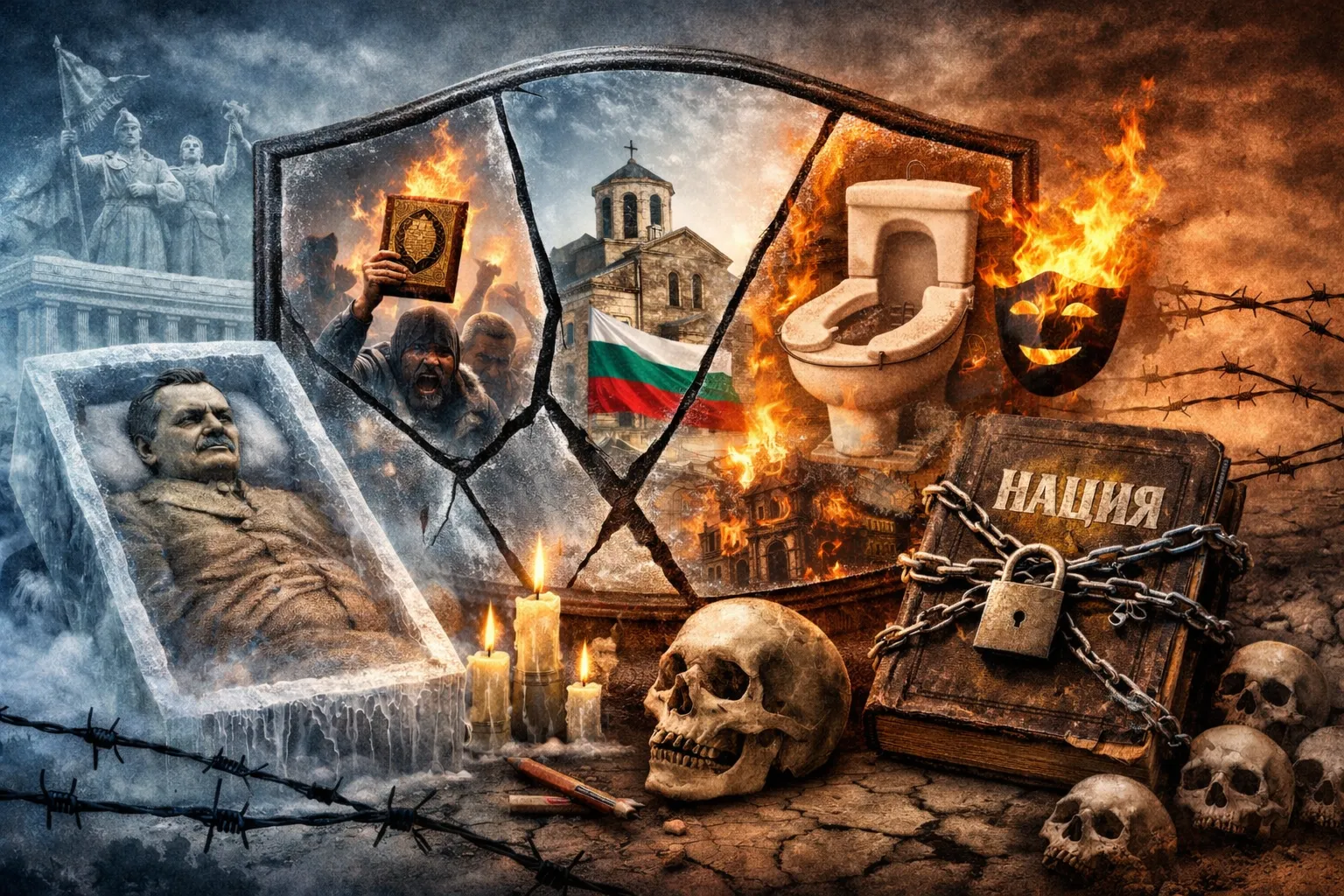
These reactions are not a matter of religion or nationality, but of the condition of ideas within different societies. When an idea ceases to develop, it can no longer be defended through arguments and begins to be defended through the threat of violence. Removed from the living public debate and placed in a kind of “pantheon-refrigerator,” it turns every attempt at reinterpretation into an attack. Only reactions of reverence and worship remain acceptable.
From this point on, the question is no longer what has been offended, but why the reaction is so predictable. To answer it, one must look at the life of ideas themselves—and the moment when they cease to live and become frozen.
By “frozen ideology” here we do not mean lies, propaganda, or deliberate manipulation. What is meant is something more banal and more dangerous: a mobilizing idea that has stopped developing but has received neither a new form nor a dignified historical conclusion.
The main symptom is simple and easily recognizable:
criticism is experienced as offense, and disagreement as an attack on the community. Where an idea is alive, debate strengthens it. Where it is frozen, everything except reverence threatens it.
Under normal conditions, great ideas have a life. They are born not from abstractions, but from real tensions—social, political, cultural. At the beginning they are usually imprecise, experimental, often contradictory. That is precisely why they are open to criticism.
Then comes the phase of expansion. The idea mobilizes, organizes, creates institutions and language. Its carriers, programs, and symbols emerge. At this stage, debate does not disappear—it is part of growth.
In its mature phase, the idea begins to allow internal differences. Schools, currents, alternative interpretations appear. This is not a sign of weakness but of strength: the idea can afford pluralism.
With time, however, aging sets in. Reality changes, problems shift, and the idea begins to lag behind. At this point there are two paths. Either it is reformed—through criticism, reinterpretation, renewal—or it is removed from the sphere of public debate. The second path leads to sacralization.
Freezing is a structural outcome, not an accident. It occurs at the moment when an idea is perceived as too important to be subjected to change. What is at stake is no longer whether it is true and fruitful, but whether the community can survive without it.
At that point, criticism ceases to be an instrument of correction and becomes a threat. Debate begins to look like subversion. The language shifts: instead of arguments, moral ultimatums are used; instead of disagreement—accusations; instead of debates—ritual apologies and punishments.
Institutions often play a key role. They have an interest in stability, predictability, canon. A frozen idea is convenient: it disciplines, creates clear boundaries and an internal enemy. The price—intellectual, and later social stagnation—is paid later.
A frozen ideology survives not because it is convincing, but because it is functional. It replaces complex thinking with identity. The defining question is no longer “is this true,” but “whose side are you on.” This offers a promise of quick moral clarity in a world that is becoming increasingly unclear.
Such an idea is a cheap form of cohesion. It requires no effort, no knowledge, no argument. The only requirement is loyalty. In return, the idea—and the ideology built upon it—offers a sense of righteousness and a common enemy: the offender, the violator, the heretic.
This is why the punitive logic does not weaken. It is not a defect, but a core mechanism. Each sanctioned case tightens the taboo and serves as a warning to others. Self-censorship is not a side effect, but the expected result.
In contemporary Islamic reactions to religious offense, this mechanism is visible with almost textbook clarity. Not simply because “religion is like that in general,” but because reform there is difficult and sacralization is already a completed fact. Criticism is perceived not as an intellectual act, but as an existential threat.
The threat of punishment does not weaken—it reproduces itself. Each new “offense” leads not to conversation, but to a repetition of the same ritual. This cannot be explained simply through the history of Islam or its characteristics, because in many places this religion is practiced in gentle and humane ways. What we are dealing with is a demonstration of a mechanism that activates wherever an idea has ceased to be discussed and has begun to be guarded.
If the causes seem obvious in these cases, why do our own reactions appear so different? Why do Bulgarian “scandals” continue to be perceived as isolated incidents rather than as symptoms?
The answer is unpleasant but simple: frozen ideologies have a habit of appearing natural from the inside. Just as a religious taboo is not experienced by the believer as taboo, but as normality, so too a national taboo is rarely recognized as such by those who live within it.
From this point on, the question is no longer abstract. It becomes local. What exactly is frozen in our case—and why does it continue to produce scandals instead of debate?
When speaking about the “nation” in a Bulgarian context, the conversation almost automatically slides toward identity: who we are, what we are like, what distinguishes us from others. But speaking of a “national project” requires a different perspective—thinking not in terms of “essence,” but of historical process. The issue here is not what we are, but how we were produced as a community.
In principle, national projects are neither organic nor natural. They are the result of deliberate, often asynchronous efforts by specific social groups (most often the intelligentsia), which, in the course of historical development, take on tasks that shape what will later be called a “nation”: articulation of a shared “we,” cultural codification, institutional consolidation, political mobilization. None of these elements alone creates a nation. The national project arises in the tension between them—in attempts to bring them into alignment, often through acceleration, simplification, and violence.
This distinction is crucial, because national mythologies do the exact opposite: they present the project as natural growth, as an inevitable path, as a morally pure line. But the project is vulnerable, interruptible, and prone to deformation. And precisely when it begins to be perceived as “natural” and “beyond question,” it becomes a danger to its own carriers.
The Bulgarian national project belongs to a specific structural subtype. Not because it is “Balkan” in a geographical sense, but because it develops within an imperial context that does not allow for slow consolidation. Stable institutional frameworks are lacking—frameworks in which cultural articulation could mature gradually. Time is compressed, the stakes are high, acceleration becomes an end in itself.
As a result, the phases of the project do not follow one another—they overlap and collide. The cultural, institutional, and political develop simultaneously, often obstructing one another, and sometimes mutually radicalizing. The state appears late, but with excessive weight—not as the result of social consolidation, but as a compensatory instrument, burdened with accomplishing “all at once” what elsewhere unfolded over generations.
From this follows the empirical fact that in such projects, violence is not an exception but a structurally available resource. Militarization is not an accidental error, but a logical consequence of a project pressed by time, external forces, and a sense of historical delay. Such a project can consolidate—but it can also deform irreversibly.
The critical moment in the “life” of any national project comes not when it is strongest, but when it begins to lose adequacy. When political goals are exhausted, reality no longer corresponds to the original mobilizing schemes, and new generations live in a different world. At this point, two outcomes are possible: rethinking or hardening.
In the Bulgarian case, the latter prevails. Instead of being reformed, the national project is removed from debate and turned into a taboo. The reasons are concrete, not abstract: the absence of a stable tradition of public critique of the national narrative; institutional self-defense of the canon; moral blackmail that equates criticism with betrayal.
Thus, after losing its capacity for aggressive, “nation-elevating” mobilization, the project does not disappear. It is frozen. It ceases to function as an instrument of orientation and begins to act as a mechanism of identification. It no longer offers goals, but boundaries. It no longer mobilizes toward the future, but guards the past.
In this context, Bulgarian cultural and historical “scandals” cease to be mysterious. They are not random eruptions, nor the result of “hypersensitivity.” They are symptoms of a frozen project that reacts not through arguments, but through defensive reflexes.
The cases of Batak, of the artistic images by David Černý, or of theatrical interpretations of Bernard Shaw all follow the same pattern: touching a sacred core, moral panic, speaking in the name of “the people,” punitive logic, and a “lesson” about the limits of the permissible. Each scandal demands a little more tightening of the taboo. Each “lesson” produces more self-censorship.
These scandals do not keep the national project alive. They attempt to preserve it by replacing debate with scandal, thinking with vigilance, and culture with a minefield.
This cost is not abstract at all. A frozen ideology produces a society in which normality appears suspicious and moderation questionable. It blocks intellectual evolution, because every new interpretation risks being declared desecration. It turns the past into a weapon, and the present into a series of recurring scandals.
And most importantly: it offers no exit. The project can no longer be “completed,” but it also cannot be “retired.” Like a mummy from the recent past, it remains suspended between death and inevitable public symbolism—frozen, yet still toxic.
What follows from all this is not a moral lesson, but the possibility of a choice. Either the national project will continue to decompose into a series of scandals that replace debate with punishment, or society will build an immunity: the right to criticism, a distinction between memory and taboo, a rejection of punitive reflexes.
Because this does not mean abandoning memory or identity—it means only abandoning freezing. And because ideologies that are not allowed to die with dignity have a habit of living long—like ghosts that haunt, above all, the inhabitants of their own homes.
[1] The name “Batak” refers to the massacre of Bulgarian civilians during the April Uprising of 1876 against Ottoman rule. In modern Bulgaria, it has become a foundational national symbol, often treated less as a subject of historical inquiry than as a sacralized narrative resistant to reinterpretation.
