

01 Sep, 2026


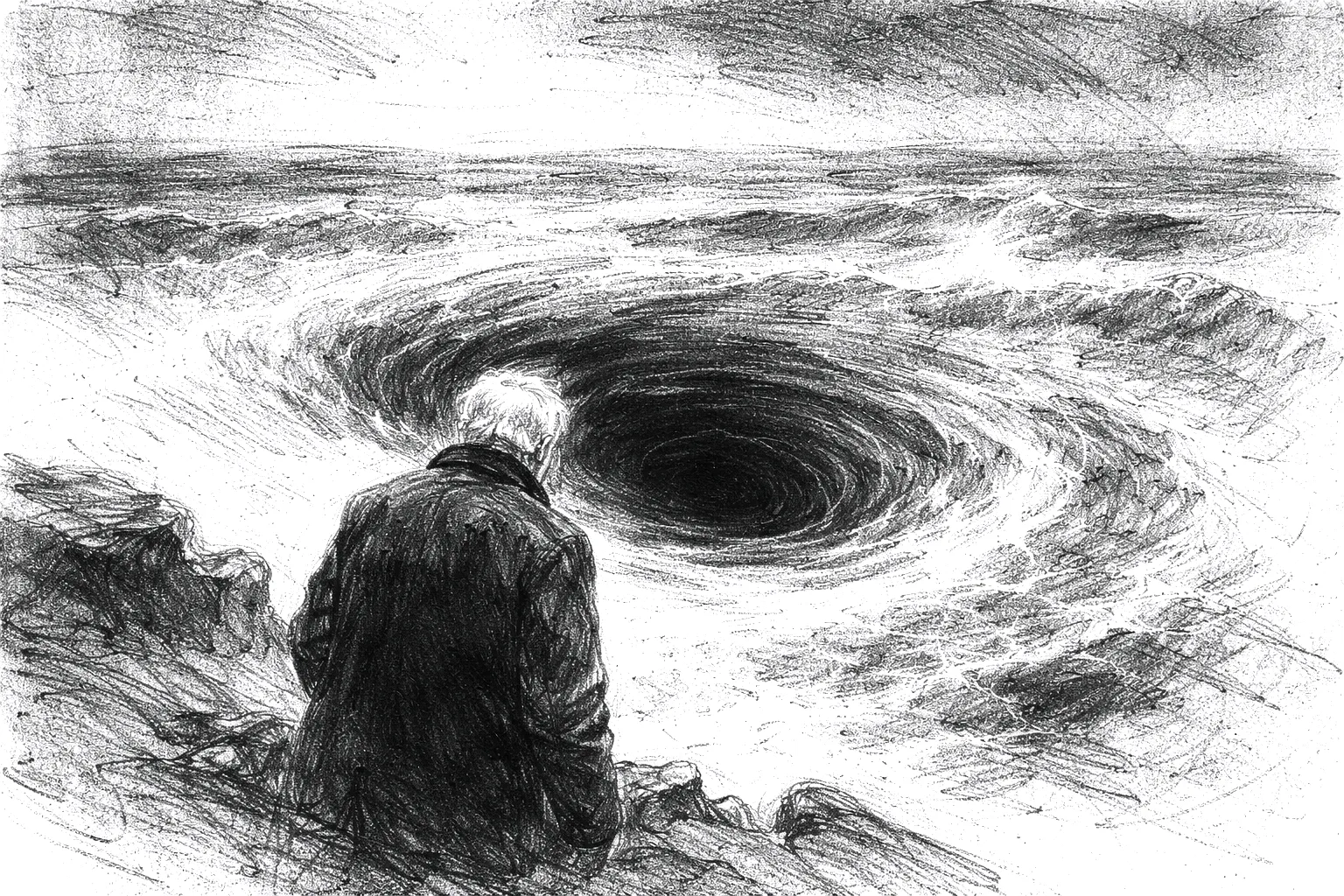
There is a story by Edgar Allan Poe—A Descent into the Maelström—that has followed me longer than most of the images I have ever carried in my head. I read it in my twenties—at an age when one still has the impudence to imagine the future as something already decided. It was not the horror that drew me, nor the spectacle of destruction. What seized my attention—if not my entire being—was the Survivor. The man who, faced with the inevitable, does not scream or pray, but observes. Who sees patterns where others see chaos. And then finds a way to adapt to them—and thus survives.
I believed I had recognized myself—instantly. Not as I was then, but as I intended to become. Eine Menschwerdung, as some of my future cohabitants—the Germans—might say.
Of course, there is nothing particularly remarkable in this, except perhaps that specific form of youthful arrogance—the conviction of one’s own immortality. It is not always loud, and it does not always boast, but its essence is absolutist, like anything that refuses to accept the inevitability of final human defeat. A more acceptable version of it assumes that when the moment comes, one will be among the few who understand (I hope that was my version).
Be that as it may.
I carried this assumption deep within myself—quietly, almost politely—through the decades that followed. Which, of course, did everything in their power to refute it.
I am now approaching the age at which such expectations should have collapsed.
And you know what? They haven’t. Not yet—shortly after my sixty-fifth birthday.
⸻ ❦ ⸻
What is interesting about aging is not decline. For me, “decline” is simply a word invented by people who need to explain why something is moving in a direction they do not desire. What interests me is something else: the increasing density of conviction—even when it is not shared by anyone else. The fact that the same inner gesture—half belief, half instinct—remains unchanged while everything around it is rearranged, worn down, or disappears.
The body, as I am often reminded, does participate in this process—inevitably. It produces signals, warnings, small betrayals. I register them with the same detached curiosity with which I read about the next war, the next crisis, the next urgent moral catastrophe. They belong to the same category: phenomena. Data. Events passing through a system I continue to experience as essentially continuous—for reasons I have never fully examined.
What I mean is: it has never really occurred to me to take them particularly seriously.
⸻ ❦ ⸻
At this point, some explanations become unavoidable.
I have friends and acquaintances. Or, more precisely—I have people who were once my age and are now something else. When I meet them—rarely, and increasingly with a kind of anthropological curiosity—what strikes me is not so much their physical condition as their position in time. They speak as if they have already entered the lower spirals of the Maelström. And they do so in a tone that is easy enough to recognize: the tone of someone who has accepted the inevitability of the direction. Their sentences carry the weight of verdicts.

In Bulgaria, this tone is almost universal.
I would not call it tragic. If anything, I would call it administrative. No five stages of Kübler-Ross, no evasions. In my country, aging is processed like documentation. The necessary forms are filled out: fatigue, resignation, minor complaints, occasional bursts of nostalgia. The file is stamped, then archived, and quietly taken out of circulation.
When I listen to them, I sometimes have the sense that I am standing at the edge of the whirlpool, watching others descend. Most of them do not complain, thank God. They make the descent in a simple, almost disciplined way. They are not dragged in. They enter on their own, without asking unnecessary questions. After the execution—worms. Before the execution—silent acceptance.
And I am expected to follow.
Yet I do not.
⸻ ❦ ⸻
I do not think there is anything heroic in this refusal, nor that it could be captured in a Faulknerian speech. For the most part, it is not even conscious. It is more like a structural defect—a premise formed too early to be removed without bringing everything else down with it.
The explanation is simple, if somewhat insane: at a certain point in my life, I stopped believing in death. I chose this consciously, after a long struggle with the obvious—and a number of late-night readings of Pascal. In the end, one believes because everything else loses.
The same applies to death, only with a minus sign in front. That is what I chose to believe, and that is how I continue to live.
Of course, I am not speaking here of death in the usual sense—as a final event that arranges life retroactively, gives it form, imposes urgency, assigns meaning. To me, this has always seemed like a narrative convenience, a structural necessity for those who require closure.
My position is simpler and, I am aware, considerably harder to defend: nothing that exists ceases to exist. It merely changes the conditions under which it is perceived.
This is not a philosophical argument. Rather, it is a working hypothesis. As I said, it is my equivalent of Pascal’s wager, if comparisons must be made. Only here the alternative is not a matter of risk. It would render the entire enterprise meaningless.
Nothing makes sense without the idea of continuity.
⸻ ❦ ⸻
Recently, a former colleague, whom I have known for forty-five years, called me “an arrogant bastard.” “You insist on being something else,” he shouted. “To you, everyone else is nothing.”
I did not try to contradict him. In a brief moment of what might be called a minor enlightenment, I understood him—and to some extent, I gave him credit. I had hurt him badly, years ago, without even realizing it. Now he was returning it—with interest. That was his reading.
⸻ ❦ ⸻
I am aware of how this sounds.
I am aware that, from the outside, such a position may be read as denial, eccentricity, or—more pragmatically—as the first symptoms of an intellectual disintegration making strenuous efforts to appear respectable. I am aware that entire disciplines exist devoted precisely to explaining such deviations from ordinary reality.
None of this carries much weight for me.
The only thing that matters is that the conviction has not weakened.
If anything has changed, it has only become clearer.
⸻ ❦ ⸻
At a certain point, I began to suspect that I had misunderstood Poe.
Not so much in the details of the story, as in its direction.
The Maelström, it turns out, is not an event. It is not something one approaches, experiences, and leaves behind. The Maelström is a state. A form of movement in which one is already situated—constantly. The point is not to avoid it, but to recognize its structure—thereby denying it the final interpretation of what is happening.
Others believe they are descending.
The Survivor understands that he is moving.
That difference is everything.
⸻ ❦ ⸻
If there is anything prophetic in all this, it does not belong to me.
Rather to Edgar Allan Poe, who has long been dead in every official sense of the word, and yet continues to speak with a clarity most of his interpreters fail to notice. His texts circulate, rearrange themselves, attach themselves to minds that did not exist when he was writing.
If this is death, it is a very peculiar one, don’t you think?
As for me, I prefer to consider him alive.
⸻ ❦ ⸻
But let me turn again to “reality”: as far as I am concerned, I find that I am aging in a way that more or less corresponds to the expectations I had decades ago. At times—disturbingly well.
Not in the details. Reality, as always, is less elegant, more repetitive, sometimes even absurd. I am speaking of the essential: I live with the sense that I remain where I always intended to be. Inside the movement—observing, adjusting, continuing.
There is a certain pleasure in this. I am not speaking of triumph, nor of justification. It is something quieter: the satisfaction of having recognized a pattern you once sensed without understanding it.
⸻ ❦ ⸻
I do not expect this position to be shared.
On the contrary—I suspect it will be met with a mixture of indifference and irritation, just as any statement that refuses to participate in the common economy of fear. That is understandable. Fear is one of the few truly collective experiences we still have.
To refuse it is to risk exclusion.
Well, so be it.
⸻ ❦ ⸻
If there is anything I would be inclined to call divine in this entire configuration, it is neither power nor knowledge, and certainly not immortality in any conventional sense.
It is the simple, stubborn fact that I have not changed my premise.
The Maelström continues to swallow. Bodies age. Files are processed. Narratives of decline repeat themselves with admirable consistency.
And somewhere within this movement, there remains a point that does not yield.
I simply happen to be in it.
For now, that is enough.
