
20 Sep, 2026


Why We Can Touch Everything and Read Nothing
For most of my adult life I could not imagine existence outside books. Reading was not merely a habit or cultivated taste; it was the environment in which thinking occurred. Books structured time, provided resistance, and created a space in which ideas could unfold patiently. The arrangement seemed so natural that I rarely reflected on it.
Today I can no longer read them.
The statement sounds theatrical, yet softer versions quickly become misleading. It is not that I read less, that my interests have shifted, or that life has grown too busy. The change is more mechanical than that. Sustained reading has become strangely difficult. Somewhere between the twentieth and fiftieth page—sometimes sooner, rarely later—attention loosens, irritation replaces curiosity, and the thread snaps.
The difficulty is puzzling because my days remain filled with text. For nearly two decades my work has consisted in reading continuously: scanning journalism, essays, commentary, criticism, filtering vast streams of information and distilling them into something manageable. In that sense I probably read more words each day than I ever did before. What has changed is something more specific: the ability to remain inside a book long enough for it to unfold in its own time.
The capacity to process ideas remains intact. Arguments can still be followed, positions compared, concepts connected. What has weakened is the slower form of attention that books require. Memory has adapted accordingly. Instead of individual works or authors it retains more diffuse structures: atmospheres of thought, conceptual constellations assembled from many sources.
For lack of a better term, I have begun to think of this condition as a modest version of what might be called the Midas Syndrome: the peculiar modern situation in which we can touch almost any book instantly, yet increasingly struggle to remain inside it.
The most common explanation for experiences like this is distraction. Modern life, we are told, has become a battlefield of competing stimuli—notifications, messages, feeds, links, constant invitations to look elsewhere. Under such conditions sustained attention inevitably weakens, and reading suffers because the mind has been trained to jump restlessly from one signal to another.
The explanation is plausible, but it does not quite fit the experience.
Distraction implies interruption. Yet the inability to read often appears in circumstances where nothing interrupts at all. The room is quiet, the device is silent, the book itself interesting. And still, after a few dozen pages, a subtle irritation emerges, accompanied by the sense that continuing would require an effort disproportionate to the reward. The text has not become difficult; the mind has simply detached.
Attention clearly survives in other forms. Long conversations remain possible, and complex essays encountered online can still be followed with interest. What emerges instead is a more specific difficulty: attention has not disappeared, but it has become reluctant to attach itself to certain kinds of objects.
Books—long, continuous, self-contained texts—now provoke a quiet resistance that shorter or more fluid forms of discourse do not.

What is weakening, in other words, is not concentration itself but the capacity to remain inside a single intellectual container for an extended period of time.
One reason for this shift may lie in the transformation of reading itself. What once meant entering a text and following its internal development from beginning to end has gradually been replaced, for many people who work with ideas, by a different activity altogether: handling information.
The daily routine increasingly resembles filtering rather than reading. Articles, essays, reports, commentary, fragments of argument circulate in a continuous stream. The task is not to inhabit each text fully but to move through many of them quickly enough to extract what matters—a concept, a perspective, a formulation that clarifies an ongoing debate.
This activity requires concentration and intellectual agility, yet its rhythm differs fundamentally from that of the book. Instead of remaining inside a single structure long enough for it to unfold, the reader moves through multiple texts, assembling patterns from their intersections. What remains in memory are not individual works but constellations of ideas—conceptual fields formed through the accumulation of many partial encounters.
Within such an environment books begin to feel strangely heavy. Their demand is simple but increasingly unfamiliar: to be followed patiently from beginning to end. The difficulty lies not in the ideas they contain—our informational environment overflows with ideas—but in the discipline of remaining with a single text long enough for its internal architecture to reveal itself.
This shift is reinforced by a second development: the strange psychology of abundance.
For most of human history the difficulty of reading lay in access. Books were scarce, expensive, and sometimes physically difficult to obtain. Acquiring one required effort and intention, and that effort already created a small commitment to the text.
Digital culture has almost completely removed this condition. Books now exist in overwhelming quantities and can be obtained instantly in electronic form. With a few taps on a screen one can acquire more material than could reasonably be read in a lifetime.
At first glance this appears to be an unambiguous cultural victory. Yet abundance produces its own psychological effects. When every book is always available, none demands attention with particular urgency. Acquisition loses its weight. A text can be opened and abandoned without consequence, secure in the knowledge that it will remain permanently accessible.
Under such conditions downloading gradually begins to substitute for reading. A book stored in a digital library creates the reassuring impression that it has somehow entered one’s intellectual life, even if its pages remain untouched. Possession begins to resemble familiarity.
The relationship between reader and book changes almost imperceptibly. The text no longer stands before the reader as a singular object demanding commitment; it becomes one possibility among thousands, permanently reversible and indefinitely postponable.
The developments described above reveal a deeper transformation in the relationship between possession and use.
For most of history the two were closely linked. To possess a book meant that one had chosen it, obtained it, and placed it somewhere within the limited physical space of one’s life. Even when unread, the object retained a quiet gravity.
Digital abundance dissolves that gravity. Books can now be acquired without cost, stored without space, and replaced without effort. The act of touching them—downloading, bookmarking, adding them to an electronic library—instantly converts them into possessions, yet precisely this ease deprives them of the weight that once made reading feel like an engagement rather than a casual option.
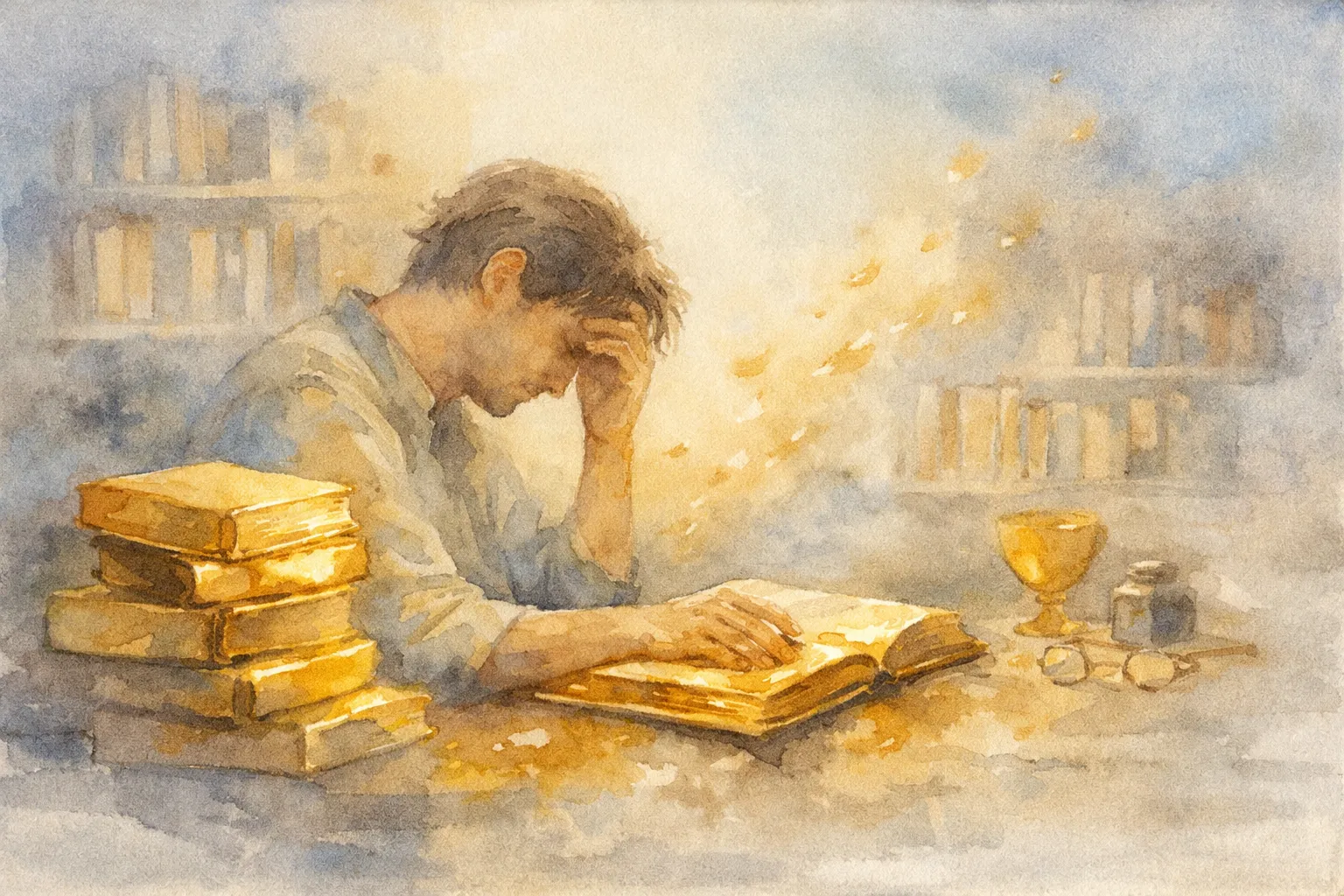
The old myth of King Midas offers a fitting metaphor. Everything the king touches turns into gold; what appears at first as a miraculous gift soon reveals itself as a curse, since objects remain present yet can no longer be used.
Something similar seems to be happening in our relationship with texts. The modern reader can touch almost any book instantly, but the very immediacy of that touch strips the object of the resistance that once made it inhabitable.
This is the Midas Syndrome.
Once the role of abundance becomes visible, another question follows: whether the medium through which we read also participates in the transformation.
A printed book imposes certain conditions almost automatically. It occupies space, has weight, and moves through time in a visibly measurable way: the growing stack of pages already read, the thinning remainder still waiting. Even the small gesture of placing a bookmark implies that the encounter will continue.
Digital reading removes most of these constraints. On a screen every page resembles the one before it, and the surrounding informational environment never disappears. Other texts, other windows, other possibilities remain only a gesture away. Leaving the book requires no more than a tap, and once closed it dissolves back into the undifferentiated archive from which it came.
In such conditions reading becomes perfectly reversible. One can begin almost anything without committing to continue it, because the act of departure leaves no trace.
Digital media are extraordinarily efficient tools for searching, comparing, and circulating ideas. Yet efficiency is not the same as inhabitation. A medium designed to facilitate constant movement between texts may quietly undermine the slower form of attention through which a book reveals its structure.
For a time it seemed obvious that the migration from paper to screens represented an unambiguous improvement. Digital books were lighter, cheaper, and infinitely reproducible. Entire libraries could be carried inside a device small enough to fit in a pocket.
Yet the disappearance of paper may have removed something less visible but equally important. The printed book imposed a modest discipline simply by existing as an object. It required a place in the room, a position in the hand, and a temporary withdrawal from the surrounding informational field.
Screens eliminate these frictions with remarkable efficiency. Their great achievement lies in making access immediate and reversible. The same gesture that opens a text can close it again without consequence. This fluidity is immensely useful, yet it also dissolves the small constraints that once helped transform reading from a casual encounter into sustained engagement.
Friction, it turns out, can function as support.
At this point discussions of reading often turn to a familiar analogy: books resemble slow meals, while digital culture produces the intellectual equivalent of fast food. The comparison contains a grain of truth but ultimately reduces the problem to discipline.
A more revealing comparison may come from nutrition science. Ultra-processed foods are engineered to minimize resistance: texture softened, flavors intensified, digestion simplified. One can consume large quantities without encountering the normal signals of saturation.
Digital texts share something of this logic. They are optimized for immediate access and effortless navigation. One can move between them with almost no friction, sampling arguments and assembling impressions without remaining inside any structure long enough for it to become fully satisfying.
Books resemble whole foods in the modest demand they place on the reader. They ask to be followed through their internal architecture—sometimes patiently, sometimes stubbornly—until the structure of the argument reveals itself. After long exposure to frictionless informational consumption this demand can feel unexpectedly heavy, yet it is precisely that resistance that once produced the peculiar satisfaction associated with finishing a book.
If the difficulty of reading arises partly from a frictionless informational environment, the solution is unlikely to consist in heroic acts of discipline. The problem is structural rather than moral.
One possible response is simply to reintroduce a measure of resistance. Certain forms of reading may benefit from environments that reduce the surrounding field of alternatives: printed books, dedicated reading devices, or spaces temporarily disconnected from the continuous informational stream.
Such adjustments are modest. They resemble the quiet constraints that once accompanied reading automatically, before the informational environment expanded to its current scale.
For centuries the cultural problem surrounding books was imagined as one of access: how knowledge might be made available to more people, how barriers of cost and scarcity might be removed. The digital age has answered those questions with extraordinary success.
Yet access alone does not produce engagement. When every text is permanently available, possession ceases to signify involvement.
We download the book, store it among thousands of others, and move on, confident that it will remain there whenever we decide to return.
The result is a curious reversal. Never before have readers been able to reach so many books so easily. Yet the same gesture that grants us access may also deprive the text of the resistance that once allowed us to inhabit it.
Everything we touch turns into possession.
And possession, increasingly, replaces reading.
