
20 Sep, 2026


Some words enter a language quietly, almost unnoticed. They appear first in conversation, then on screens, and eventually in writing. Before long they are everywhere, and no one remembers exactly when they arrived. Alongside them remain older words—“our” words—that do not disappear but begin to sound slightly out of place, as if they no longer quite fit the situations into which we force them. Not because they are wrong, but because the world around them has changed its tempo.
This is where the quarrel usually begins. Some insist that the language is deteriorating. Others reply that it is evolving. Both claims sound confident, and both sound strangely exhausted. The argument rarely concerns the words themselves. Beneath it lies a more diffuse anxiety: the feeling that something is slipping away from us, that we are losing control over something we once believed to be secure. When we insist that a word should not be used, we are almost never arguing about linguistic precision. What we are really defending is our place in the world.
The Bulgarian language has not lived in calm times for a long while. It has become more than a means of communication; it carries expectations no language can bear without strain. Into it we have loaded memory, survival, dignity, even morality. Words here are rarely heard as mere meanings. They are heard as positions. The way you speak becomes not only a question of what you say but of who you are—and very often of whose side you are on. Under such pressure, every linguistic change begins to feel like a threat.
The sharpness of the reactions comes from this tension. Not because the language itself is in danger, but because too much insecurity has been stored inside it. When someone reacts angrily to a new word, they are rarely defending grammar. More often they defend the feeling that something stable still exists—something that does not depend on foreign tempos, foreign habits, or foreign centers of gravity. Language becomes the last place where we can still say: this is ours.
Yet the greatest anxieties about the “purity” of language rarely arise from speech itself. They do not emerge from everyday conversation, from writing, or even from slang. They arise from a different sensation altogether: the realization that we are no longer the center around which the world turns. Words arrive from elsewhere faster than we can absorb them. Reality moves at a speed to which our internal habits respond only with difficulty.
This sensation is not imaginary. Bulgaria truly does live in a world where many of the words, concepts, and models come from outside. That is simply a historical fact. The problem begins only when this fact is experienced as a moral humiliation. At that moment language becomes a substitute battlefield for far more difficult conversations—about dependence, about peripheral status, about the absence of real influence. Instead of asking why words arrive from elsewhere, we begin arguing about whether they should be allowed to arrive at all.
From this point an attractive illusion takes hold: that if we preserve the “purity” of language, we will somehow preserve ourselves. If we stop the words at the gate, we imagine we can stop the world as well. The impulse is understandable, but deeply misleading. Language, however much we might wish otherwise, is neither a fortress nor a final line of defense. It cannot compensate for a lack of weight, nor can it substitute for a sense of direction. What it can do—perhaps its most honest function—is reflect how we actually live and think at a given moment.
Language is, above all, a habit. It is the way we orient ourselves in the world, organize experience, and distinguish between what matters and what does not. When the world changes rapidly, that habit begins to creak. Not because it is defective, but because it was formed under different conditions. There is nothing shameful in that creaking sound. The real question is how we hear it: as a signal for adaptation, or as proof of decline.
The external pressure on language becomes most visible where there is no time for principles: at work, in the media, and in digital everyday life. In these environments words are not carefully selected; they are simply used—quickly, functionally, without sentiment. No one sits down to “transmit cultural identity” when writing an email, preparing a presentation, or participating in an online discussion. These situations demand language that works immediately.

Office life provides the clearest example. You work in a Bulgarian company, speak with Bulgarian colleagues, yet your vocabulary is filled with words that are not Bulgarian. Not because someone imposes them, but because they belong to the organization of work itself. Meetings are “meetings,” tasks are “tasks,” deadlines are “deadlines.” No one uses them to appear modern. They are used because the rules, the software, and the logic of work have come from elsewhere. Insisting rigidly on Bulgarian equivalents is not incorrect—but it often sounds less like living speech than like a late editorial correction.
The media offer an even clearer illustration. Headlines, podcasts, and online videos exist in permanent competition for attention. There is little patience there for elaborate explanations. The words that circulate most easily are short, recognizable, and already loaded with meaning beyond the language itself: “trend,” “influencer,” “hate,” “scandal.” They arrive with their own context, which may not be Bulgarian but is instantly recognizable. When the media adopt them, they are not betraying the language. They are adapting to a rhythm they do not control.
The digital world makes this dynamic even more obvious. Social networks are not merely platforms for communication; they are ready-made linguistic systems. They come with their own verbs, gestures, and expectations: like, share, scroll. These forms arise not from ideology but from bodily practice—the movement of the finger, the speed of reaction, the habit of responding within seconds. Translating them into carefully purified Bulgarian is possible, but the result often sounds like instructions from another world.
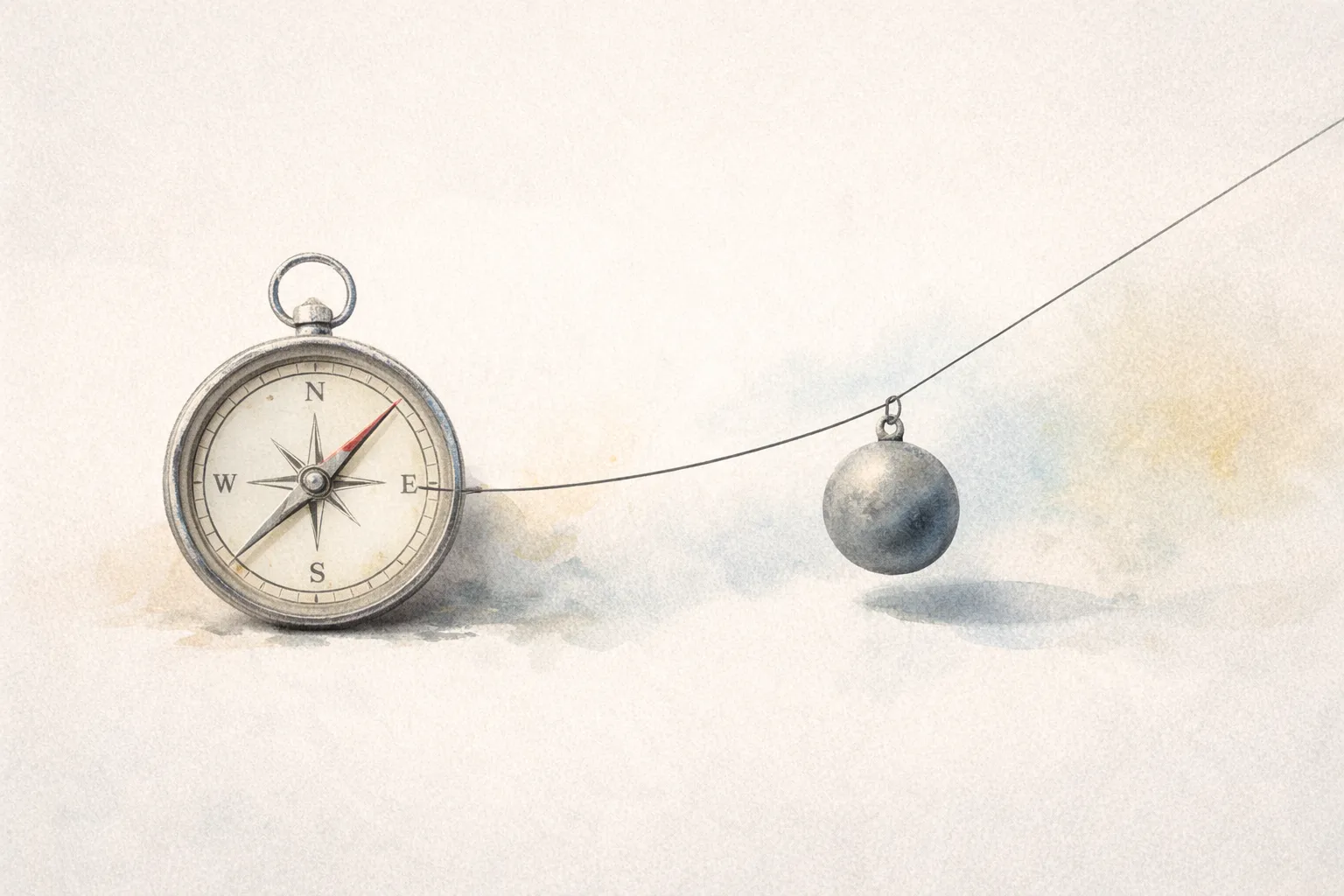
Here the metaphor of gravity becomes unavoidable. No one forbids us to speak Bulgarian. No one forces particular words upon us. Yet the environment is structured so that some words simply do more work with less effort. They carry ready-made meanings, international recognition, and technical precision. By comparison, Bulgarian equivalents often feel longer, less precise, or burdened with older associations.
This is not cultural aggression in the classical sense. No one is forcing us to march. The terrain itself has changed. As with physical gravity, the question is not whether you believe in it but whether you can ignore it. The more stubbornly you pretend it does not exist, the more exhausted you become.
But there are also situations where gravity does not press from outside at all—we open the door to it ourselves.
Public commentary offers a revealing example. In studios and newspaper columns one frequently hears about “narratives,” “discourses,” “consensuses,” and “paradigms.” Not because Bulgarian lacks words of its own, but because these terms arrive with ready-made authority. Using them signals belonging. Speech begins to serve not so much clarification as positioning. The question becomes not what do I think? but which conversation do I belong to?
Something similar happens in education. University texts and lectures often contain constructions that feel translated silently in the mind rather than spoken aloud. Sentences grow long and heavy, governed by a foreign syntax. They are not incorrect, yet they feel unnatural. Reading them, one senses that the thought was not born in Bulgarian but merely passed through it.
Translation itself offers an especially telling example. This is precisely the place where a language should demonstrate its strength. Yet here too we often encounter literal constructions, preserved foreign word orders, and expressions that resemble molds rather than thoughts. The problem is not incompetence but excessive caution: translators fear losing something from the original. Bulgarian shrinks in order to accommodate the foreign text instead of reshaping it. Translation ceases to be an act of creation and becomes an act of submission.
Even in small, intimate contexts the same dynamic appears. Consider the way people describe themselves professionally—in short biographies, profiles, and self-presentations. Bulgarian words like “experience” or “skills” are often replaced with terms such as “expertise,” “skill set,” or “focus.” Not because the Bulgarian words are insufficient, but because the borrowed ones seem more convincing in a world where evaluation appears to come from elsewhere. Language adjusts itself to the imagined gaze of another.
What all these situations share is simple: no one is being forced. There is no prohibition, no pressure, no sanction. That is precisely why they matter. Here gravity has already become habit. It no longer feels like an external force but like a natural standard. Speak differently and no one will accuse you of being wrong. You will simply sound strange—or provincial, or unserious.
These choices are rarely discussed because they are uncomfortable. They raise questions not about words but about motives. Why do we believe some forms carry more weight than others? When does Bulgarian begin to seem insufficient—and for whom? These are not questions of correctness but of confidence.
At this point the debate usually arranges itself conveniently: either we defend the language or we surrender it. Either we remain ourselves or we fall under influence. The opposition sounds clear but is misleading. Both positions respond to the same underlying feeling—that the center of gravity lies somewhere else.
Defending linguistic purity is not a strategy but a reaction. It appears after influence has been lost, not before. When language is burdened with the role of final defense, it usually means other forms of defense have already failed. Purity then becomes consolation—a way of restoring the feeling of control without changing the environment in which we live.
Yet the opposite attitude offers no better solution. Accepting ready-made forms simply because they work saves effort but accumulates dependence. When language adjusts itself entirely to a foreign rhythm, it ceases to function as an instrument of thought and begins to resemble an interface.
These attitudes are not opposites but mirrors. Both avoid a more difficult question: how does one live and think in a world where one does not set the rules yet remains responsible for the way one speaks?
Language cannot compensate for a lack of influence. The more we burden it with that task, the more distorted the conversation becomes. We begin arguing about words instead of conditions, about correctness instead of direction, about origins instead of use.
The real alternative is not between purity and decay. It is between thought and automatism—between a language that demands effort and one that merely slides along ready-made forms. That effort cannot be imposed through bans or revived through nostalgia. It begins where we stop pretending that language can save us from a world in which we refuse to take a position.
Language will not rescue us from that world. But it can help us understand it—if we stop using it as a shield and begin using it as a tool. Not in order to sound correct, but in order to think precisely.
That is the harder path. And the only one that prevents language from becoming a substitute for thought.
