

01 Sep, 2026


or
How the Actors Change, but the Rules of the Game Do Not
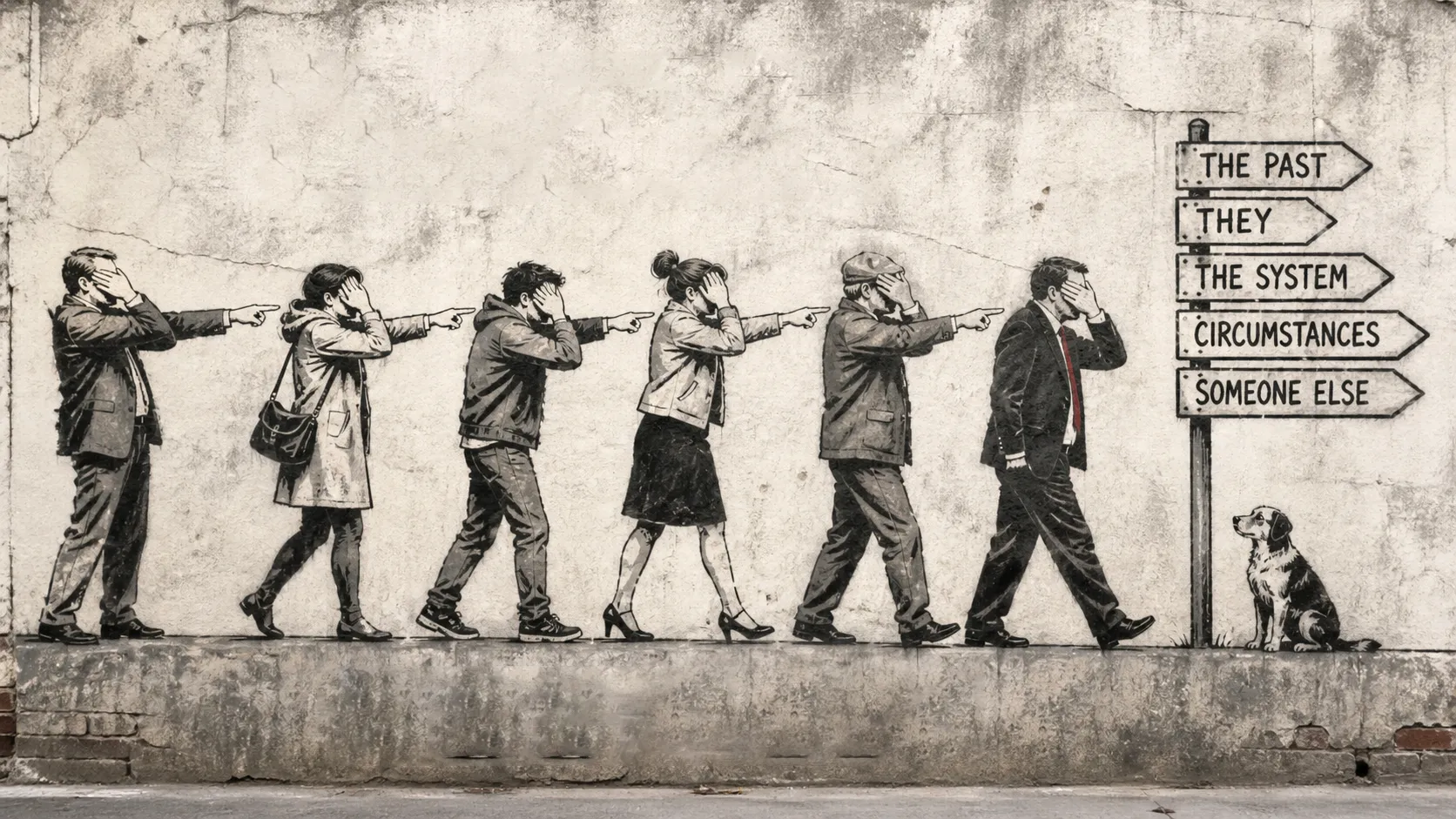
Bulgarian history is rarely told as something we ourselves have done. It almost always arrives from outside—as invasion, betrayal, conspiracy, a foreign will imposed upon an otherwise innocent body. Ottoman rule was inflicted upon us. Communism was brought to us. The post-1989 transition was imposed on us. The European Union dictates to us. America uses us. Russia abandons us. Brussels humiliates us. Globalism dissolves us. The names change, but the structure remains the same: history is something that happens to us, not something we do ourselves.
This is not merely a propagandistic habit, but one of the most durable technologies of Bulgarian self-consciousness. The nation imagines itself first and foremost as an injured subject. Even when it wins, it wins as a victim; even when it exercises violence, it experiences it as forced self-defense. Within this logic, there is no room for the idea that history might also be our own work. We do not make mistakes—we are misled. We do not choose wrongly—we are always betrayed. We bear no guilt—injustice is done to us.
This is precisely where one of the great difficulties of Bulgarian public language lies: it has a very low tolerance for the idea of our own historical responsibility. Responsibility presupposes agency. It requires the recognition that something was not merely suffered, but also carried out; that certain decisions were supported, certain regimes accepted, certain illusions voluntarily chosen. This is far heavier than external accusation. To say „they ruined us“ is bearable. To say „we participated“ is devastating.
That is why the national narrative prefers fate to action. Fate demands no moral responsibility. It is tragic, but convenient. It allows suffering and moral superiority at the same time. The people are poor, but pure; humiliated, but righteous; defeated, but morally uncorrupted. This is a deeply attractive position. It frees us from the need to think politically. If everything is decided by external forces, then history is not a field of choice, but a stage for endurance.
That is also why antifascism and anticommunism in Bulgaria so often resemble one another, despite claiming to be mutually exclusive. Both positions operate through the same mechanism: exporting guilt outward. In one case, evil comes from „monarcho-fascism,“ imposed by reactionary elites and foreign interests; in the other, from the „Soviet occupation,“ which interrupted the country’s otherwise natural path. In both cases, society remains innocent. History once again becomes a foreign crime committed against a voiceless national victim.
But this is not only an intellectual deception; it is also a psychological defense. A people forced to accept that it not only suffered, but repeatedly participated in its own catastrophes, must bear an enormous inner burden. It is much easier to live with the image of betrayed innocence than with that of shared responsibility. Innocence is bearable. Responsibility destroys biographies, family legends, entire generations of moral self-protection.
This is exactly why the disputes around September 9, 1944[1] cannot be understood merely as disputes about communism.
These disputes are a much deeper mirror. In them we see not only a regime change, but our inability to think of history as our own action. The question is not simply who arrived with the tanks, but why so many people were ready to accept what came with them. No less important is the question of what older habits of state and society made that acceptance possible.
The real work begins where we stop asking „Who did this to us?“ and begin asking questions like „Why was this once again possible here?“ Such questions are far more dangerous. Because they do not seek an external culprit, but an internal structure. That is precisely why Bulgarian political culture avoids them so stubbornly.

September 9, 1944 is usually presented as an absolute rupture—the moment when „normal“ Bulgaria disappeared and something foreign took its place, imported from outside, incompatible with the country’s previous state logic. This picture is convenient. It allows communist violence to be understood as a historical anomaly, a Russian disease, a temporary deviation from an otherwise natural national path. But this is precisely where one of the greatest falsifications of Bulgarian memory begins.
The political regime undoubtedly changed radically. Ideology changed, property changed, international orientation changed, the language of power changed. But something else changed far less: the very way in which the Bulgarian state understood the exercise of power. There, continuity is far more unpleasant.
The comparison almost no one wants to make is between 1923–1926 and 1944–1948. Not because the two periods are identical—they are not, and any mechanical symmetry here would be false—but because in both cases the state reacts to political conflict in a similar way: not through inclusion, but through the liquidation of the opponent.
In the first case: coup d’état, destruction of the Agrarian movement, mass persecution of the Left, extrajudicial killings, the physical neutralization of political and intellectual opponents. In the second: the People’s Court, liquidation of the old elites, destruction of the Right, repression against autonomous social centers, the systematic removal of possible competition. The differences in scale, organization, and ideological framework are enormous; the structural reflex, however, remains recognizable.
The communist regime did not simply repeat the old model—it centralized it, radicalized it, and transformed it into a permanent technology of rule. That is precisely why it must not be trivialized through easy analogies. But it is equally false to present it as something that simply fell from the sky. The principle itself did not emerge from nothing. It already existed: the state not as an arbiter between conflicts, but as an instrument for resolving conflict once and for all through the elimination of one side.
This is the key reflex. Not pluralism, but neutralization. Not political rivalry, but the moral delegitimization of the opponent. Not temporary victory, but the erasure of the very possibility of an alternative. In such a system, the opponent is not a competitor, but a danger to the very existence of the state. Therefore, his removal is not a crime, but a form of state necessity.
The intelligentsia stands at the center of this logic. Not because it is „left-wing“ or „right-wing,“ but because every autonomous intellectual environment represents a potential source of disloyalty. The university, the independent press, professional communities, free cultural authority—all of these create an alternative center of legitimacy. For a state accustomed to thinking of power as monopoly, this is structurally intolerable. That is why the assault on the intelligentsia is not an ideological exception, but a recurring pattern.
The convenient myth says that communist violence was imported from outside and therefore does not belong to Bulgarian history, but merely infected it. This frees us from a very heavy question: what within Bulgarian state culture itself made this form of rule so easily recognizable and functional? If everything is simply a „Russian disease,“ then we do not have to look at our own administrative instincts, our own tradition of preventive violence, our own weakness for the state as punishing father.
It is precisely here that September 9 becomes uncomfortable. It reveals not only rupture, but continuity. Not only foreign occupation, but local readiness. Not only a new regime, but an old habit in a new form. This does not excuse communist terror—on the contrary, it makes it more frightening. Because it means that it was not simply a historical catastrophe arriving from outside, but the radicalized manifestation of something that had already been here.
And if this is true, then moral comfort disappears. We can no longer say: this was not us. We must say something much harder: the system changed, but the rules of the game remained familiar. The actors changed, but not the stage.
One of the greatest mistakes of the Bulgarian conversation after 1989 was the belief that socialism could be described solely as a system of repression, lies, and economic inefficiency—and that this description would be enough to settle the historical argument. From the perspective of moral judgment, this seems logical. From the perspective of social memory, it does not.
Because a huge part of society did not experience that regime primarily as ideology, but as the first form of its own historical visibility.
After 1989, public discourse was dominated by circles for whom socialism truly meant loss: loss of property, of family continuity, of social status, of symbolic capital, of the right to one’s own biography. This was a real experience, and it produced a powerful moral language. But it was not universal. Very often it was presented as national truth, even though for enormous masses of people—especially outside the old urban and hereditary elites—the experience was different.
For millions of Bulgarians, socialism meant not dispossession, but a first entrance into history. Generations that came out of the village entered the city. People without inherited capital received education, an apartment, an administrative position, a pension, institutional weight. Not because the system was just, but because for the first time the state included them as visible people.
They did not read the regime as a philosophical construction. They lived it as biographical ascent.
Here something appears that crude anticommunism almost never understands: dignity is often stronger than economics. People do not remember GDP. They remember that their father had been nobody, while they became engineers. That the family had lived in mud, and then had an apartment. That their name began to mean something in the institutional world. This is not statistics. This is moral memory.
Yes, equality was often false. Yes, the system was built on fear, censorship, and lies. But the social feeling of dignity can be entirely real even inside an economically illusory construction. Humiliation and recognition are not measured only by income. They are measured by whether your life appears legitimate in the eyes of the world.
This is precisely why crude anticommunism fails. When you tell millions of people that they lived inside an entirely false system, you are not merely criticizing a regime. You are delegitimizing their own lives. You are not attacking the Party—you are attacking the memory of their parents, their labor, their sense that they were not superfluous. This is not experienced as historical analysis, but as personal humiliation.
That is why the defense of socialism so often has nothing to do with any real defense of dictatorship. Most people are not defending State Security, censorship, or the camps. They are defending something much deeper: the meaning of their own biography. They refuse to accept that their entire life must be read as a historical mistake.
It is here that the convenient moral scheme of „victims versus perpetrators“ begins to fall apart. History becomes more uncomfortable. A regime can be repressive and still provide a sense of social form. A system can be unjust and yet be experienced as dignity. If we do not understand this, we will never understand why 1989 was not experienced only as liberation.
From here begins the next humiliation—not political, but biographical. Because when a regime falls, it is not only its institutions that fall. The moral legitimacy of the life lived inside it falls as well. And that is far harder to endure than any change of power.
In the Bulgarian public narrative, 1989 almost always appears as liberation—a return to normality, to Europe, to the true history interrupted in 1944. This description is partly true and at the same time deeply insufficient. Because for an enormous part of society, the transition was not only liberation, but a second historical annulment of their own lives.
The first annulment came with communism. Prewar biographies—especially those of the old urban strata, property owners, hereditary professional and cultural elites—were morally and socially delegitimized. What was taken away was not merely wealth, but the very right to tell one’s life as legitimate. The old world was declared exploitative, reactionary, historically guilty. Entire family memories became suspect.
After 1989, the mechanism repeated itself in reverse. Now it was the socialist biography that had to be rewritten. The new official narrative said: you lived in a lie. Your security was false. Your career was the product of a defective system. Your sense of order was morally compromised. Your normality was a historical delusion.
This was the second humiliation. And it was often heavier precisely because it came in old age, when a person no longer has time to build a new version of himself. The young can change the language of the world. The old have to watch their entire lives being translated into a foreign moral vocabulary. Not simply poverty, but retrospective meaninglessness.
Here is born what is so often, and so lazily, called „nostalgia for communism,“ as if it were a matter of love for dictatorship. In most cases, this is a crude misunderstanding. People are not defending the regime. They are defending the right of their lives not to be declared historical waste. They are not saying: we want the Party back. They are saying: do not explain to me that everything I was amounted to nothing.
That is why the transition was experienced not only as an economic catastrophe, but also as a moral sentence. Privatization, unemployment, the collapse of institutions—these were only the visible part. Beneath them lay something deeper: the feeling that the world had suddenly refused to recognize your previous form of existence. That your life experience was no longer worth a penny. That the language in which you had understood yourself had been canceled.
This explains the strange durability of nostalgia even where no one actually wants a return to the old regime. Nostalgia is not a political program. It is a defense against humiliation. It is an attempt to preserve at least the moral value of what was lived. To say: yes, the system was what it was, but my life inside it was not a lie.
Here the most unpleasant symmetry appears. Both communism and the transition operate through a similar mechanism: official narrative, official moral judgment, official amnesia. Every new order begins with the moral annulment of the previous one. First the previous world is erased in the name of the new. Then the new world is erased in the name of the next. Every regime declares the one before it not merely wrong, but morally invalid.
Thus society remains in a permanent regime of retrospective self-denial. There is never accumulation, only periodic amnesties and new indictments. No one is an heir—everyone is either a victim or an accused.
This is what makes 1989 such a difficult place for honest conversation. Because the real question is not whether the transition was necessary. It was, of course. The question is why liberation once again had to be experienced as humiliation. And why every new historical legitimacy in Bulgaria seems possible only through the destruction of the one before it.
The phrase „things were better back then“ usually provokes automatic contempt. It is heard as political blindness, as a rejection of freedom, as proof of provincial attachment to dictatorship. But very often it means something entirely different. Not an ideological position, but a last attempt by a person to save the moral value of his own existence.
People rarely mourn the regime as an abstract system. They mourn the comprehensibility of the world. The feeling that life had a form, that the rules—even bad ones—were understandable, that tomorrow belonged to some predictable order. Freedom by itself is not enough consolation if it arrives together with the feeling that the world has ceased to be habitable.
Predictability is not only an economic category. It is a moral one. A person may live with hardship, but if he knows what his labor means, where he stands in society, what he can expect from tomorrow, he possesses a form of dignity. After 1989, many people lost not only income. They lost the coordinates through which they understood themselves.
Equality at a low level also has moral force, which liberal triumphalism often refuses to understand. Because this is not about wealth, but about the absence of humiliating comparison. Poverty is bearable when it is shared; it becomes destructive when it turns into a constant public proof of one’s own inadequacy. The new world brought not simply inequality, but the continuous visibility of someone else’s superiority. Psychologically, this is far more brutal.
After 1989, many people experienced not only impoverishment, but the collapse of the world as a structure. The factory disappeared. The institution disappeared. The profession ceased to mean what it had meant. The pension became a humiliation. The city changed. The language of respect changed. A person did not merely lose a job—he lost a form of existence. This is not compensated by the abstract phrase „you are free now.“
That is why nostalgia is often a defense against contempt. It says: do not explain to me that my entire life was a mistake. Do not take from me the last right to believe that my efforts had meaning. Do not turn my own past into proof of inferiority.
In this sense, nostalgia is not a refusal of reality, but a refusal of moral annihilation.
And here we return to the deepest problem: Bulgarian innocence. If everything was imposed from outside—communism, the transition, poverty, corruption, failure—then no one bears responsibility. Not for the choice of the regime, not for the patience toward it, not for the way it was destroyed, not for what came after it. What remains is only an endless victim-nation, waiting for the next external culprit.
This is the final refusal of responsibility. And it is the most dangerous one. Because it makes history endlessly repeatable. A people that cannot acknowledge its complicity in its own catastrophes is condemned to experience them again under new names.
The real question was never „Who did this to us?“ That question is convenient precisely because there is always a ready answer to it, and it almost never requires self-recognition. The real question is different: when will we admit that we participated in the process of choosing, sometimes with genuine, unfeigned enthusiasm? Not in everything. And not alone. Not in full freedom. But enough to bear responsibility.
September 9 is not simply a date. It is a test of historical maturity. And precisely for that reason it becomes a mirror. The most unpleasant thing in it is not the foreign force, but our own reflection.
[1] September 9, 1944 marks the communist seizure of power in Bulgaria, backed by the entry of the Soviet Red Army. In Bulgarian historical memory, it functions as one of the great symbolic dividing lines of the twentieth century—something like a national shorthand for the beginning of the communist regime.
